
FedEx Surcharges
Surcharges, at their core, are additional fees added on top of the shipping cost for your order by FedEx (or any other carrier). They can add up quickly and often go unnoticed unless you are monitoring with a recurring parcel invoice audit.

Featured In











Shipping Rates & Contract Negotiation
At ShipSigma we manage, analyze, and optimize over $1Billion in parcel spend to provide you with a deep understanding of the excess of fees your contract has built in and where savings exist. Using our industry-leading cost modeling software, we'll provide you with a Shipping Savings Guarantee before you negotiate. Once negotiation begins, we'll provide you with a market-best carrier network strategy, contract management & compliance services, surcharge mitigation, and ongoing analysis and optimization opportunities.
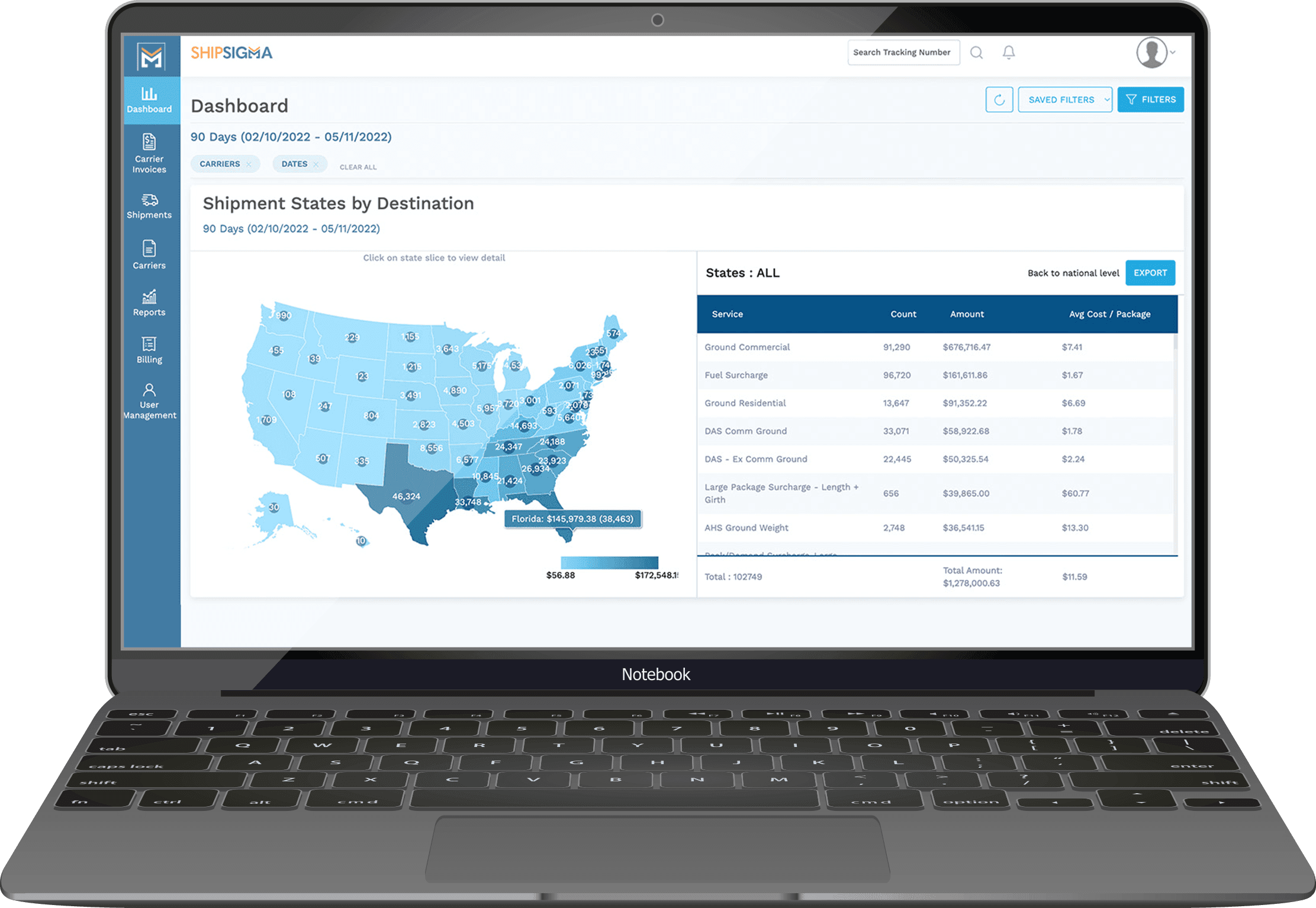
Know Your Savings Before You Negotiate
“We could not say enough good things about our relationship with ShipSigma. Beyond the initial savings, they continue to find us new angles for savings, set up dashboards specific to our needs, and meet with us quarterly to go through reporting/review savings/new opportunities. ShipSigma has been more than just a service for us, they have been a continuous partner as we navigate the difficulties of controlling our freight costs and holding the vendors accountable.”
“4 hours. It took less than 4 hours of my time for my company to see half a million in annual savings. No headaches, no feet-dragging negotiations, no confusing documents. It was so easy.”
“The insights and analytics, ShipSigma provided before and after negotiating our carrier agreements, make it clear we have a long-term partner who is aligned with our company values. The cost modeling and rate simulation let us know the exact savings we would see, down to the last cent. After running our historical data, ShipSigma was able to find us almost 28% in annual shipping savings with our same carrier.”
“Our team managed billions of dollars of various category spend. To have ShipSigma guarantee a savings and then fully execute so that we’re realizing increased EBITDA within 60 days allows us to focus on other strategic opportunities.”
“We thought we had the best rates. We were told we had the best rates. ShipSigma got us better rates. They found us nearly 25% in savings and helped us renegotiate our contract with our carrier. It was just so easy.”
“The parcel invoice audit was a lifesaver for us. The team at ShipSigma monitored the weekly audit and noticed that instead of shipping air, over 60% of our packages could have traveled ground with no delay in arrival. They saved us more money than we had ever saved in our manual audit process.”
FedEx Surcharges
The price on a FedEx invoice is rarely the price a business expects to pay. FedEx applies dozens of surcharges on top of base transportation rates. For high-volume shippers, those surcharges represent a significant and growing share of total shipping cost. In 2026, the combination of annual general rate increases, expanded delivery area classifications, and year-round demand surcharges has made surcharge management a P&L-level concern for any business spending $500K or more on FedEx annually.
Understanding which FedEx surcharges apply to your shipping profile, how they are calculated, and where they are negotiable is the difference between absorbing carrier margin increases and controlling them.
What Types of Surcharges Does FedEx Charge?
FedEx applies dozens of distinct surcharges on top of published base transportation rates. For high-volume shippers, these FedEx surcharges are not marginal line items. They represent 20% to 40% or more of total FedEx shipping fees on a given invoice, and in some shipping profiles, surcharges exceed the base rate itself.
The core categories of FedEx surcharges include fuel surcharges (variable, indexed to weekly published prices), residential and delivery area surcharges (applied by destination type and ZIP code), and package characteristic fees (additional handling, oversize, dimensional weight, and overweight). Peak and demand surcharges apply during capacity-constrained periods. Service-specific accessorial fees cover Saturday delivery, signature required, declared value, and dangerous goods handling.
FedEx Ground surcharges, FedEx Home Delivery surcharges, and FedEx Ground Economy surcharges each operate on separate rate schedules. A package moving through FedEx Ground to a commercial address carries a different surcharge profile than the same package routed through FedEx Home Delivery to a residential address. Businesses that ship across multiple FedEx service levels need to track surcharge exposure across their entire service mix to get an accurate FedEx shipping cost breakdown.
Additional billing and accessorial fees appear in common scenarios that shippers overlook: FedEx address correction fees ($25.50 per correction in 2026) when a recipient's address is invalid or incomplete, FedEx third-party billing surcharges when freight charges are routed to a third-party account, FedEx weekly pickup fees for scheduled recurring pickups, and FedEx on-demand care surcharges for special handling requests. Each adds cost at the shipment level, and at volume, the cumulative effect is substantial.
Understanding which surcharges stack on a single shipment is the first step toward identifying where a business is overpaying. Consider a single FedEx Home Delivery package shipped to an extended delivery area ZIP code. That package carries a base rate, a $6.45 residential delivery surcharge, a $6.60 delivery area surcharge, and a fuel surcharge calculated as a percentage of the total. During peak season, a demand surcharge layers on top. Without invoice-level visibility, these charges compound undetected.
What Are the Changes to FedEx Surcharges in 2026?
FedEx's 2026 surcharge environment continues a pattern that has intensified each year since 2020: annual general rate increases (GRIs) paired with targeted surcharge escalations that compound faster than the headline GRI percentage suggests. The published 5.9% average GRI for 2026 does not capture the full cost impact, because surcharge-specific increases are applied independently and many exceed the GRI rate.
The most structurally significant change for 2026 is the addition of cubic volume criteria to the Additional Handling Surcharge and Oversize Charge, effective January 12. Packages exceeding 10,368 cubic inches now trigger the Additional Handling Surcharge, and packages exceeding 17,280 cubic inches or 110 lbs actual weight trigger the Oversize Charge. These criteria apply alongside existing length-plus-girth thresholds. A package measuring 30" x 24" x 24" (17,280 cubic inches) now triggers the Oversize Charge even though it falls well under the 96" length and 130" length-plus-girth thresholds.
FedEx demand surcharges and FedEx peak surcharges have also evolved structurally. These fees once appeared exclusively during the November-through-January holiday window. FedEx now applies demand-based surcharges during any period of capacity constraint throughout the year, creating cost spikes that are difficult to forecast using historical seasonal patterns alone. For shippers budgeting transportation costs quarterly, demand surcharges introduce volatility that base rate discounts do not offset.
Residential delivery-related fees saw above-average increases for 2026. The FedEx Ground and Home Delivery residential surcharge increased 8.4%, from $5.95 to $6.45 per package. The residential delivery charge for U.S. Package Services (Express) increased from $6.55 to $6.95, a 6.1% increase. FedEx has also expanded the ZIP codes classified as extended and remote delivery areas, which means shippers serving the same customer base see delivery area surcharge exposure grow even when their shipping volume and destinations remain unchanged.
Businesses that have not renegotiated their FedEx carrier contracts since 2024 or earlier are absorbing the full weight of these FedEx shipping rate increases with no contractual protections. Surcharge caps, waivers, and negotiated discount floors erode with each successive GRI cycle when they are not actively maintained. This makes 2026 a critical year to revisit carrier agreement terms.
The Most Costly FedEx Surcharges Explained: Residential, Delivery Area, and Address Correction
Three surcharge categories account for a disproportionate share of total surcharge cost for most mid-market and enterprise shippers: residential delivery, delivery area, and address correction. Each is assessed per package, and each is driven by factors (destination type, geography, and data quality) that compound at high volume.
FedEx Residential Delivery Surcharge
The FedEx residential delivery surcharge is applied to every package delivered to a residential address rather than a commercial location. FedEx Home Delivery inherently carries residential classification, so the surcharge is built into the service at $6.45 per package in 2026. FedEx Ground applies the surcharge when its address classification system flags the destination as residential. For shippers with a high residential delivery ratio, this surcharge alone represents a material percentage of total shipping cost.
The FedEx residential pickup surcharge adds a separate per-package fee when FedEx collects a shipment from a residential origin address. Businesses operating from non-commercial facilities, home offices, or residential warehouses face both origin and destination residential surcharges on the same shipment.
FedEx Delivery Area Surcharge
The FedEx delivery area surcharge (DAS) is triggered when a shipment's destination ZIP code falls within FedEx's designated extended or remote delivery zones. FedEx publishes its FedEx delivery area surcharge ZIP code list annually, and the list has expanded in each of the last several update cycles. Shippers need to cross-reference their customer address database against the current DAS ZIP code list to forecast exposure accurately, because the classification of a given ZIP code changes without notice to the shipper.
For 2026, the residential delivery area surcharge is $6.60 per package, with extended and remote tiers carrying progressively higher fees (remote area surcharges now approach $17 per package). Businesses shipping to rural markets, agricultural regions, or mountain communities face disproportionate surcharge exposure. For companies with a geographically dispersed customer base, delivery area surcharges exceed residential surcharges as a cost driver.
FedEx Address Correction Fee
The FedEx address correction fee is charged when FedEx corrects an invalid, incomplete, or undeliverable address during transit. For 2026, the fee is $25.50 per correction, a 6.25% increase from $24 in 2025. At the per-package level, the fee is a single line item. At volume, the math changes entirely.
A shipper processing 50,000 monthly shipments with a 2% address error rate generates 1,000 address corrections per month, or $25,500 in monthly fees ($306,000 annually). Implementing address validation at the point of order entry eliminates the majority of this exposure.
What Is the FedEx Additional Handling Surcharge and How Do Oversize Charges Work?
Package characteristic surcharges penalize shipments that exceed FedEx's standard size, weight, or packaging thresholds. These fees are among the highest per-package charges in the FedEx surcharge schedule, and they are assessed before any other surcharges are applied to the same shipment.
FedEx Additional Handling Surcharge
The FedEx additional handling surcharge applies to packages that meet any of several triggering criteria: the longest side exceeds 48 inches, the second-longest side exceeds 30 inches, the package is not enclosed in a standard corrugated shipping container (including polybag shipments), or the combined length and girth exceed 105 inches. As of January 12, 2026, packages exceeding 10,368 cubic inches in cubic volume (length x width x height) also trigger this surcharge.
The surcharge applies per package and ranges from $29.50 to $58.75 depending on the zone, service type, and which threshold the package triggers. For shippers of irregularly shaped, oversized, or non-standard products, additional handling fees accumulate across every qualifying shipment.
FedEx Oversize Charges
FedEx oversize charges are triggered when a package exceeds maximum dimensional thresholds: length plus girth greater than 130 inches, or as of January 2026, cubic volume greater than 17,280 cubic inches or actual weight greater than 110 lbs. When a package is classified as oversize, FedEx replaces the dimensional weight calculation with a minimum billable weight of 90 lbs, which dramatically increases the effective per-package cost.
For 2026, oversize charges for U.S. Package Services range from $255 per package (Zone 2) to $330 per package (Zones 7+). For businesses shipping bulky goods, furniture, or large industrial components, oversize charges represent a disproportionate share of total surcharge spend. The question of how to avoid FedEx oversize charges comes down to packaging engineering: auditing product-level packaging specifications against FedEx's current dimensional thresholds and right-sizing containers to keep measurements below the cutoff.
FedEx Dimensional Weight Surcharge
FedEx calculates dimensional weight by applying a DIM divisor to the package's length, width, and height in cubic inches. When the resulting FedEx dimensional weight exceeds the actual weight, FedEx bills the higher figure. For lightweight but bulky products (apparel, foam-packaged electronics, promotional materials), DIM weight billing is a significant and consistently underestimated cost driver. The gap between actual weight and dimensional weight is where carriers extract margin on every package, and reducing that gap through packaging optimization directly reduces per-shipment cost.
FedEx Overweight Package Fee
The FedEx overweight package fee applies to shipments exceeding 150 pounds. For businesses shipping heavy industrial, commercial, or equipment products, this fee signals a cost inflection point. Shipments above the 150-pound threshold should be evaluated on a shipment-by-shipment basis against LTL freight options, because the parcel surcharge rates on overweight packages are structured to discourage heavy-package volume within the parcel network.
How Much Is the FedEx Fuel Surcharge and What Drives It?
The FedEx fuel surcharge is a variable, percentage-based fee applied to base transportation charges on every shipment. FedEx publishes weekly fuel surcharge tables indexed to fuel price data from the U.S. Energy Information Administration (EIA), and the rate adjusts on a defined schedule throughout the year. The fuel surcharge is not optional, not negotiable to zero, and not fixed. It fluctuates with the market.
FedEx Parcel Fuel Surcharge (Ground and Express)
For FedEx Ground and FedEx Express shipments, the fuel surcharge is applied as a percentage of the base shipping rate on each package. FedEx Express fuel surcharges are indexed to the U.S. Gulf Coast (USGC) jet fuel spot price. FedEx Ground fuel surcharges are indexed to the national on-highway diesel average. Both indices are published weekly by the EIA.
When the average price falls within a certain range in FedEx's published table, the corresponding percentage is applied to the base rate. As prices rise, the percentage increases. As prices fall, the percentage decreases. The table updates every Monday and applies to shipments picked up the following week. FedEx Ground and Home Delivery services use one fuel surcharge table. FedEx Express services use a separate (and higher) table. Businesses with a mixed service profile face different effective fuel surcharge rates depending on which service handles each shipment, which means a single "fuel surcharge percentage" does not exist for most shippers.
For high-volume shippers, a 1 to 2 percentage point increase in the fuel surcharge rate translates to tens of thousands of dollars in additional annual cost. Fuel surcharge caps are one of the most valuable contractual levers available in a carrier contract negotiation. A cap sets a ceiling on the fuel surcharge percentage regardless of where the EIA index moves, insulating the shipper from the most volatile component of carrier pricing.
FedEx Freight Fuel Surcharge (LTL)
For FedEx Freight shipments, including LTL, the fuel surcharge is calculated on a per-mile basis, where distance is a direct variable in the formula. This reflects the operational reality of long-haul freight, where consumption scales with the length of the haul. The per-mile fuel surcharge follows this calculation: subtract the carrier's base price from the current average price, divide by the truck's average efficiency (miles per gallon), and multiply by the total shipment distance.
Businesses with LTL freight exposure under FedEx face a floating surcharge that shifts week over week. In a volatile environment, the effective LTL fuel surcharge rate diverges significantly from the parcel fuel surcharge rate, and most shippers do not reconcile the two. Tracking both the weekly published rates and their correct application to your invoices is where businesses identify and recover overcharges.
How Do FedEx Surcharges Affect Total Shipping Costs?
The cumulative impact of FedEx surcharges on total shipping spend is frequently underestimated, particularly by businesses that focus primarily on negotiating base rates. Here is what the math looks like at scale.
Consider a mid-size business shipping 50,000 packages per year through FedEx Home Delivery, with a mix of residential and rural deliveries. On a base rate of $15.00 per package, a single residential shipment to a delivery area surcharge ZIP code with an additional handling flag carries the following charges: base rate ($15.00), residential delivery surcharge ($6.45), delivery area surcharge ($6.60), additional handling surcharge ($29.50 at Zone 2), and fuel surcharge (applied as a percentage of the combined charges). The total surcharges on that single package exceed the base rate.
Across the full shipping volume, surcharges routinely account for 25% to 40% of total spend. A shipper expecting $750,000 in annual cost based on base rates alone is paying $1M or more once surcharges are layered in. The challenge for most businesses is that surcharges are buried across individual invoice line items and are difficult to aggregate without dedicated auditing tools. Significant overpayment on surcharges goes undetected because businesses lack the visibility to see where the money is going.
How Can You Reduce and Avoid FedEx Surcharges?
Reducing FedEx surcharges requires action on two fronts simultaneously: operational improvements that prevent avoidable charges at the shipment level, and contractual negotiations that reduce the rate on charges that cannot be eliminated.
Operational Improvements
Implementing address validation at checkout eliminates the majority of FedEx address correction fees. At $25.50 per correction in 2026, the return on investment for clean address data is immediate at any shipping volume.
Right-sizing packaging to the product being shipped reduces FedEx additional handling surcharges and FedEx dimensional weight surcharges. With the new cubic volume thresholds effective January 2026, packaging optimization is more consequential than in prior years. Auditing product-level packaging specifications against FedEx's current oversize thresholds eliminates one of the highest per-package fees in the schedule. These are structural changes that generate savings on every shipment going forward, and they compound at volume.
Contractual Negotiation
Businesses shipping $500K or more annually have meaningful contractual position to negotiate surcharge waivers, caps, and discounts directly into their FedEx carrier agreement. Common negotiable elements include residential delivery surcharge reductions, delivery area surcharge waivers for specific ZIP codes or tiers, fuel surcharge caps that insulate the shipper from weekly index fluctuations, and peak surcharge waivers or caps during defined seasonal periods.
Negotiating lower surcharge rates with FedEx is a question of data: shippers who understand their own cost structure at the line-item level, and who understand carrier profitability on their specific shipping profile, negotiate from a position of clarity rather than assumption. Working with a team experienced in carrier contract negotiation ensures surcharges are addressed alongside base rates, not after.
Zone Optimization
Routing shipments from distribution facilities geographically closer to end customers reduces base transportation costs and simultaneously reduces or eliminates delivery area surcharge exposure by shifting volume away from extended and remote ZIP codes. Zone optimization is a strategic lever that compounds across base rates, fuel surcharges, and accessorial fees.
Service Mix Analysis
Shifting residential shipments to FedEx Ground Economy, or evaluating FedEx vs. UPS surcharges for specific delivery zones, produces measurable per-shipment savings without service degradation visible to the end customer. Service mix analysis identifies shipments where a lower-cost service level delivers the same transit time and customer experience at a lower total landed cost.
AI-Powered Surcharge Analytics
Invoice-level analytics platforms apply surcharge calculations to every charge line on every invoice, automatically flagging miscategorized packages, unexpected surcharge applications, and patterns of avoidable fees. This turns surcharge reduction from a periodic manual exercise into a continuous, data-driven process. ShipSigma's AI, built and trained on over 20 billion parcel and LTL data points, performs this analysis at the line-item level across a shipper's full invoice history, identifying every dollar of recoverable and preventable surcharge spend.
How Do You Dispute Unexpected FedEx Surcharges and Audit Your Invoice?
FedEx invoice auditing should be a systematic, shipment-level process. Each charge line requires review against the contractual rate card, published surcharge schedules, and actual package-level data to identify billing errors, duplicate charges, misapplied fees, and surcharges that do not match shipment characteristics.
Common Disputable Surcharges
Surcharges that are frequently applied in error include FedEx additional handling fees assessed on packages that do not meet the triggering dimensional or weight thresholds, FedEx signature required fees charged without a corresponding delivery instruction, and FedEx international surcharges applied to domestic shipments. Other common errors include FedEx third-party billing surcharges applied to shipments where billing instructions were correctly captured at origin, FedEx declared value surcharges applied to shipments with no declared value election, and FedEx dangerous goods surcharges applied to non-regulated commodities.
Dispute Windows
FedEx defines dispute windows of 15 to 180 days depending on the charge type. Businesses that do not audit invoices on a rolling basis forfeit their right to recover overbilled amounts once the window closes. For high-volume shippers processing thousands of invoices monthly, unclaimed credits represent significant annual revenue leakage that compounds with every billing cycle.
Automated Invoice Auditing
A third-party parcel invoice audit partner with AI-driven reconciliation identifies overcharges at a scale and speed that manual review does not match. ShipSigma's platform processes millions of charge lines against contract terms, published rates, and shipment-level data to surface every recoverable credit. One ShipSigma client, a high-volume B2C technology hardware shipper with $15.7M in annual spend, recovered $3.45M annually (18.5% of total spend) through a combination of contract re-engineering and ongoing invoice auditing. The audit process surfaced billing patterns that revealed both carrier errors and operational inefficiencies that, once corrected, prevented future overcharges.
FedEx Ground Economy Surcharges
FedEx Ground Economy (formerly FedEx SmartPost) is a contract-only service designed for lightweight, non-urgent residential deliveries, and it carries its own surcharge schedule distinct from standard FedEx Ground. For e-commerce shippers with high residential volume, the critical difference is that Ground Economy is exempt from the standard $6.45 residential delivery surcharge that applies to FedEx Ground and Home Delivery packages.
Ground Economy shipments are still subject to delivery area surcharges ($6.60 for residential DAS ZIP codes in 2026), fuel surcharges, additional handling fees, and peak/demand surcharges ($2.20 to $3.55 per package during peak periods). The service is positioned as a lower-cost option for lightweight parcels. Businesses shipping 500 or more residential packages per month stand to save thousands in residential surcharge fees alone by routing qualifying shipments through Ground Economy where transit time requirements allow it.
FedEx vs. UPS Surcharges: Which Carrier Is More Cost-Effective for Your Shipping Profile?
The FedEx vs. UPS surcharges comparison does not have a single answer. The cost-effective carrier depends entirely on the shipper's specific package weight distribution, dimensional profile, destination zone mix, residential vs. commercial delivery ratio, and service level requirements. A carrier that is cheaper for one shipper's profile is materially more expensive for another's.
Residential Delivery Comparison
FedEx Home Delivery surcharges and UPS's equivalent residential surcharges track closely at the published rate level but diverge by zone and by service-specific accessorial fees. FedEx Saturday delivery surcharges, on-demand care surcharges, and extended delivery area fees differ from UPS equivalents in both rate and triggering logic. Shippers with significant rural or remote delivery volume find meaningful cost differences carrier to carrier within specific geographic corridors.
Accessorial Cost Structure
The FedEx Saturday delivery surcharge is a discrete fee that makes weekend delivery meaningfully more expensive. Businesses that do not require Saturday delivery but have it enabled by default in their FedEx service configuration are incurring avoidable charges at scale. FedEx weekly pickup fees and FedEx on-demand care surcharges add to the total cost of the carrier relationship. Evaluating the full accessorial cost structure, not just base rate discounts, is essential for a legitimate cost comparison between the two carriers.
Data-Driven Carrier Allocation
The most accurate FedEx vs. UPS surcharges analysis requires running both carriers' rate engines, including all applicable surcharges, against actual historical shipment data. ShipSigma's cost modeling technology, trained on over 20 billion data points across 350+ companies, automates this comparison at the shipment level. The output is a shipment-by-shipment allocation model that identifies the lowest total landed cost by carrier for every package in the shipper's volume, enabling evidence-based carrier allocation decisions rather than blanket carrier commitments.
Take Control of Your FedEx Surcharges With ShipSigma
FedEx surcharges in 2026 are more numerous, more variable, and more costly than in any prior year. For businesses spending $500K to $100M annually on shipping, surcharge-related costs represent a material portion of total carrier spend. Most organizations are leaving significant money on the table through overbilling, unconsolidated volume, and carrier agreements that have not been re-engineered since the last GRI cycle.
Reducing FedEx surcharges requires continuous monitoring of invoice-level data, proactive contractual negotiation at every renewal cycle, operational adjustments to packaging and address management, and ongoing analysis of the carrier cost structure as FedEx publishes rate changes throughout the year.
ShipSigma's AI, built and trained on over 20 billion parcel and LTL data points, gives businesses the intelligence to understand exactly where FedEx surcharges are eroding margins and which charges are disputable. The platform models what a carrier contract should look like relative to the full market of negotiated agreements. ShipSigma has served 350+ companies and delivered an average cost reduction of 25.2%, without changing carriers or service levels.
ShipSigma works alongside each client's team, advising on the impact of every cost decision, audit finding, and surcharge adjustment, combining platform-level intelligence with the ongoing support of a dedicated partner who is accountable to results throughout the year.
If your business is absorbing FedEx surcharges without a systematic strategy to audit, negotiate, and reduce them, the cost of inaction compounds every month. Connect with ShipSigma to find out exactly how much you are overpaying and what you are able to recover.
Frequently Asked Questions
How much do FedEx surcharges add to the cost of shipping?
FedEx surcharges represent 20% to 40% or more of total shipping fees for high-volume shippers. The exact amount depends on the shipper's package characteristics, destination mix, service levels, and whether surcharges stack on individual shipments. Residential delivery, delivery area, fuel, peak, and additional handling surcharges all apply to the same package when triggering criteria are met.
What is the FedEx delivery area surcharge ZIP code list?
FedEx publishes an annual list of ZIP codes classified as standard, extended, or remote delivery areas. Packages shipped to these ZIP codes trigger the FedEx delivery area surcharge at a per-package rate ($6.60 for residential standard DAS in 2026). The list has expanded in recent update cycles, meaning shippers serving the same customer base see delivery area surcharge exposure grow even when their destinations remain unchanged.
How does FedEx calculate dimensional weight?
FedEx applies a DIM divisor to a package's length, width, and height in cubic inches. When the resulting dimensional weight exceeds the actual weight, FedEx bills the higher figure. For lightweight but bulky products, dimensional weight billing is a significant cost driver that packaging optimization reduces directly.
Can I negotiate lower FedEx surcharge rates?
Businesses shipping $500K or more annually have meaningful contractual position to negotiate surcharge waivers, caps, and discounts into their FedEx carrier agreement. Common negotiable elements include residential delivery surcharge reductions, delivery area surcharge waivers for specific ZIP codes or tiers, fuel surcharge caps, and peak surcharge waivers during defined seasonal periods.
What is the dispute window for FedEx surcharges?
FedEx defines dispute windows of 15 to 180 days depending on the charge type. Businesses that do not audit invoices on a rolling basis forfeit their right to recover overbilled amounts once the applicable window closes.
Is FedEx or UPS cheaper for residential deliveries?
There is no universal answer. The cost-effective carrier depends on the shipper's package weight distribution, dimensional profile, destination zone mix, and service level requirements. A shipment-by-shipment analysis using both carriers' full surcharge schedules against actual historical data is the only accurate comparison method.
How does a parcel invoice audit reduce FedEx surcharges?
A parcel invoice audit reviews each charge line against the contractual rate card, published surcharge schedules, and actual package data to identify billing errors, duplicate charges, and misapplied fees. Consistent auditing also surfaces operational patterns (packaging issues, address data quality problems) that, once corrected, prevent future overcharges.
What changed about FedEx oversize and additional handling charges in 2026?
Effective January 12, 2026, FedEx added cubic volume criteria alongside existing length-plus-girth thresholds. The Additional Handling Surcharge now applies to packages exceeding 10,368 cubic inches. The Oversize Charge now applies to packages exceeding 17,280 cubic inches or 110 lbs actual weight. These changes flag packages that previously cleared the older dimensional thresholds, expanding the number of shipments subject to these high-value surcharges.
What is FedEx Ground Economy and how do its surcharges differ?
FedEx Ground Economy is a contract-only service for lightweight, non-urgent residential deliveries. Its primary surcharge advantage is exemption from the standard $6.45 residential delivery surcharge applied to FedEx Ground and Home Delivery packages. Ground Economy shipments are still subject to delivery area surcharges, fuel surcharges, additional handling fees, and peak/demand surcharges.