
SmallParcel Audit
Our small parcel audit (or parcel invoice audit) claims and credits all eligible refunds to your account by analyzing your shipping invoices.

Featured In










Parcel Audit Software
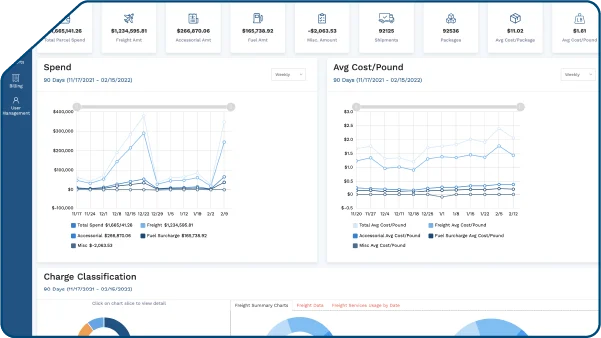
Our audit and reporting platform automatically identifies any and all invalid charges using the power of AI and machine learning.
- Fully automated invoice auditing
- 50+ audit points including late shipments, invalid surcharges, & lost and damaged packages
- Contract Compliance
- Automatically identify, submit, and verify claims
- Reduce the cost of every shipment
- Instant savings
Save Big with our Parcel Invoice Audit
“We could not say enough good things about our relationship with ShipSigma. Beyond the initial savings, they continue to find us new angles for savings, set up dashboards specific to our needs, and meet with us quarterly to go through reporting/review savings/new opportunities. ShipSigma has been more than just a service for us, they have been a continuous partner as we navigate the difficulties of controlling our freight costs and holding the vendors accountable.”
“4 hours. It took less than 4 hours of my time for my company to see half a million in annual savings. No headaches, no feet-dragging negotiations, no confusing documents. It was so easy.”
“The insights and analytics, ShipSigma provided before and after negotiating our carrier agreements, make it clear we have a long-term partner who is aligned with our company values. The cost modeling and rate simulation let us know the exact savings we would see, down to the last cent. After running our historical data, ShipSigma was able to find us almost 28% in annual shipping savings with our same carrier.”
“Our team managed billions of dollars of various category spend. To have ShipSigma guarantee a savings and then fully execute so that we’re realizing increased EBITDA within 60 days allows us to focus on other strategic opportunities.”
“We thought we had the best rates. We were told we had the best rates. ShipSigma got us better rates. They found us nearly 25% in savings and helped us renegotiate our contract with our carrier. It was just so easy.”
“The parcel invoice audit was a lifesaver for us. The team at ShipSigma monitored the weekly audit and noticed that instead of shipping air, over 60% of our packages could have traveled ground with no delay in arrival. They saved us more money than we had ever saved in our manual audit process.”
Small Parcel Audit
If you ship at scale on UPS or FedEx, you have already done significant work to negotiate strong rates with your carrier. You used your volume, your data, and your relationship with the carrier rep to secure terms that worked for the business at the time. The work that comes next is different. It is the discipline of confirming, every billing cycle, that the contract you negotiated is the contract you are actually being billed against.
A small parcel audit is the structured process that does that work. It examines every line item on every carrier invoice, identifies discrepancies between contracted terms and applied charges, and recovers the dollars that contract-aware analysis surfaces. For high-volume shippers, a routine audit program is the difference between a contract that performs on paper and one that performs on the ledger.
What is a small parcel audit?
A small parcel audit is the systematic review of carrier invoices for shipments under 150 pounds, conducted to identify billing errors, missed refunds, surcharge misapplications, and contract noncompliance. It covers shipments handled by UPS, FedEx, DHL, and regional parcel carriers. The discipline applies equally to ground, express, air, and international parcel services within carrier-defined weight and dimensional thresholds.
For businesses spending $1M to $100M annually on shipping, small parcel auditing is both a transactional and strategic function. The transactional layer recovers dollars on individual shipments where carrier billing diverged from contract terms. The strategic layer surfaces patterns across thousands of invoices that inform how carrier relationships, surcharge exposure, packaging strategy, and overall small parcel shipping costs should be structured going forward.
A small parcel is any individual package that moves through a carrier's ground, express, or air network and falls within carrier-defined weight and dimensional thresholds. Above 150 pounds, the shipment classifies as freight. Within those thresholds, the small parcel category is the highest-volume, most invoice-dense piece of most shippers' transportation spend. That density is exactly what makes it the highest-impact place for an audit to recover dollars.
Without a structured audit program, billing discrepancies accumulate without notice. Carriers do not self-report errors, and they do not proactively issue credits. The full burden of identification, claim filing, and credit confirmation sits with the shipper. That is why most companies delegate this function to a dedicated parcel audit company once shipping volume crosses a meaningful threshold.
What types of errors does a parcel audit find?
Carrier invoices are dense, and the volume that flows through them creates room for systematic parcel billing errors that compound across billing cycles. A carrier invoice audit examines every line item against the shipper's contracted rate structure, the shipment's actual characteristics, and the carrier's published service commitments. The shipping invoice discrepancies that surface fall into several recurring categories.
Duplicate shipping charges are among the most financially damaging errors. The same shipment is billed twice across consecutive invoice cycles, a problem that manual spot-checking does not catch at volume. Rate misapplication is the next layer down, where the carrier applied a rate tier, service level, or discount structure that does not match the negotiated terms in the carrier contract.
Shipping overcharges manifest in additional forms. Incorrect zone assignments place a shipment in the wrong rate band. Unauthorized service upgrades convert a ground shipment into express. Invalid address correction fees apply when the original address was complete and correct. Residential delivery surcharges hit clearly commercial destinations. Each error category has a defined dispute path and a finite window for filing the claim.
Beyond individual transactions, a comprehensive shipping invoice audit surfaces systemic billing patterns. A surcharge appearing on the same lane week after week is a different problem than a one-off duplicate. Pattern identification gives operations and finance teams the evidence they need to challenge carrier billing practices structurally, rather than disputing individual charges in isolation. ShipSigma's platform processes invoices against more than 20 billion parcel and LTL data points, which is what makes pattern detection at this scale meaningful rather than anecdotal.
What are accessorial charges in parcel shipping?
Accessorial charges are fees layered onto the base shipping rate when specific delivery conditions apply. Residential delivery, address correction, oversized packaging, remote area delivery, signature requirements, and additional handling all generate separate line items on the carrier invoice. Each carries its own carrier-defined criteria for when it should and should not apply.
The problem is that accessorial charges frequently appear on invoices when those criteria are not met. A residential delivery surcharge can hit a verified commercial address. An address correction charge can post against a shipment with a clean original address. An additional handling fee can apply to a package within standard dimensional and weight limits. An accessorial charges audit checks every applied fee against the shipment's actual characteristics and the carrier's own published criteria.
Fuel surcharges deserve their own audit logic. The variable fuel surcharge percentage applied to each invoice should match the carrier's published weekly rate table for the correct service type. A calculation error of even fractional percentage points, multiplied across thousands of shipments, creates compounding overcharges that finance teams rarely catch until a structured audit surfaces them.
Address correction charges should only apply when a shipper submits an incorrect or incomplete address. Auditing these fees against the original shipment record and the carrier's own delivery confirmation data identifies cases where the fee was applied despite a valid original address. For e-commerce and B2C shippers, where address quality is largely outside the shipper's control, this single category accumulates into recoverable six-figure sums on annual invoices.
What is dimensional weight auditing?
Dimensional weight pricing charges shippers based on the greater of a package's actual weight or its dimensional weight, calculated from length-by-width-by-height divided by the carrier's DIM divisor. A dimensional weight audit challenges the dimensions the carrier recorded for each shipment.
When a carrier overstates dimensions, whether through measurement equipment error or inconsistent application, the shipper is billed at an inflated billable weight. Across a high-volume operation, a few cubic inches of overstatement on a recurring product configuration drives meaningful overcharges every billing cycle. The audit compares the carrier's recorded dimensions against the shipper's own packaging specifications for that product line.
For shippers with consistent product configurations, dimensional weight audits frequently identify systemic patterns rather than one-off errors. When a specific SKU consistently bills at a higher dimensional weight than its actual packaging warrants, both the recovered credits and the prevention of future overcharges become structural improvements to cost-to-ship. That structural shift produces compounding savings rather than one-time refunds.
How do I claim a refund for a late UPS or FedEx delivery?
A carrier service failure occurs when a carrier delivers a shipment after its committed delivery time on a service that carries a money-back guarantee. Both UPS and FedEx state that delivery as little as 60 seconds past the published commitment time triggers the guarantee on eligible services. The shipper is entitled to a refund or credit of the base transportation charges for that shipment.
The refund is not automatic. Both carriers require the shipper to file the claim within 15 calendar days of the invoice date for FedEx, or within 15 days of the scheduled delivery date for UPS. Past that window, the refund is forfeited regardless of the merit of the claim. For high-volume shippers processing thousands of shipments per week, manual identification and dispute filing within that window is operationally impossible without automation.
The universe of services eligible for the money-back guarantee has narrowed since 2020. Both UPS and FedEx have suspended guarantees on most ground and deferred-air services, with periodic reinstatements on select products. Eligibility now varies by service, by season, and by carrier-declared peak periods. An automated audit program tracks the current eligibility status of each service and files only on shipments that qualify, which is the difference between filing every late shipment and filing every claimable late shipment.
Approved late delivery refunds appear as credits on a future invoice, generally within one to three billing cycles after the claim is filed. A disciplined shipping refund recovery program does more than file claims. It tracks pending credits, confirms their application against the right account, and flags instances where approved credits are not properly reflected. That secondary verification step is where additional shipping cost recovery frequently surfaces.
What is the difference between a manual and automated parcel audit?
A manual parcel audit involves internal staff downloading carrier invoices, cross-referencing line items against shipping records, and individually filing disputes. The process is time-intensive, error-prone at volume, and practically limited to reviewing a fraction of total invoice lines. For any operation processing more than a few hundred shipments per week, manual review recovers only a small share of the dollars that are actually recoverable.
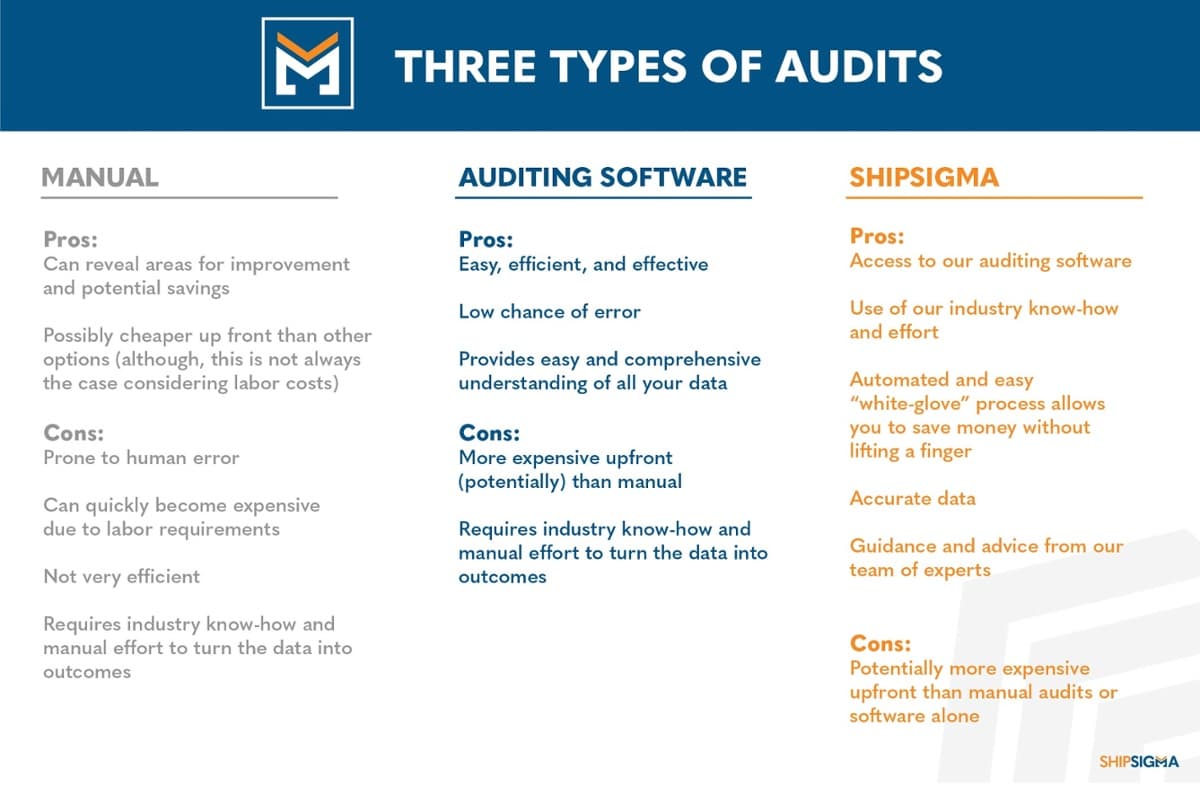
An automated parcel audit ingests carrier invoice data electronically, applies rule-based and AI-driven logic to flag every billable discrepancy, and generates dispute filings automatically. Every invoice line gets reviewed every cycle, and disputes file inside the carrier's claim window with no manual queue. Parcel audit software integrates directly with TMS, ERP, and carrier portal systems through API or EDI connections, which removes the data-export bottleneck and ensures audit logic applies in near real time.
Shipping analytics built into a shipment auditing platform turn raw audit data into operational intelligence. Carrier performance trends, surcharge frequency by lane, service failure rates by origin-destination pair, and spend variance by business unit all become visible at the dashboard level. These insights inform decisions that go beyond individual refund recovery, including service-level selection, packaging changes, and carrier mix.
The parcel audit ROI of a well-implemented automated solution exceeds the cost of the platform itself, particularly when the audit data feeds carrier contract negotiations and ongoing spend optimization. ShipSigma's customers have averaged 25.2% in cost reduction across more than 350 companies and over $150 million in total savings. The result comes from combining audit recovery with the broader cost analysis the platform produces.
Should I use in-house or third-party parcel auditing?
In-house parcel auditing requires dedicated headcount with carrier contract expertise, access to carrier portals across all active carriers, and the time bandwidth to review invoices every billing cycle. That investment is difficult to justify unless shipping volume and internal logistics expertise are both exceptionally deep. For most mid-market shippers, the math favors choosing to outsource parcel auditing rather than carry the function in-house.
Outsourcing small parcel auditing to a parcel audit company removes the internal resource burden and provides immediate access to specialized carrier billing expertise and dispute-filing infrastructure. Parcel audit services are most commonly priced on a contingency basis, where the provider earns a percentage of the refunds and credits recovered. The model aligns the provider's incentives with the shipper's financial outcome and creates a zero-cost entry point for businesses that have never run a structured audit before.
Freight audit and payment services extend the audit scope beyond small parcel into LTL and truckload freight. For shippers operating multi-modal networks, that combined scope produces a unified view of carrier billing accuracy and recovery opportunity across the full transportation budget. A direct-to-consumer bicycle brand engaged ShipSigma with limited parcel-level data and identified more than $800,000 in savings opportunity. A PE-backed industrial manufacturer recovered $1.2M (23%) on $5.2M in lifetime spend, with first-quarter savings exceeding $250K.
When evaluating a third party parcel audit provider, the depth of carrier contract expertise matters more than the surface features of the software. The provider should audit against your specific negotiated contract terms, not against published rates. They should serve as a strategic advisor, not a refund processor. And they should provide transparent reporting that demonstrates value beyond individual claim recovery, which is the test that separates audit vendors from audit partners.
How do parcel audits help with carrier contract negotiations?
Carrier contract negotiation outcomes are directly determined by the quality of the data the shipper brings to the table. A comprehensive audit history documents service failure rates, surcharge frequency, lane-level spend distribution, and billing error patterns at a granularity carriers cannot dispute. That evidence base is what allows shippers to challenge specific pricing structures and negotiate improved terms with the carriers they already trust.
Parcel spend management is the practice of actively monitoring, analyzing, and optimizing every component of parcel carrier spend. The discipline goes beyond recovering past errors. It structures ongoing carrier relationships, service selections, and packaging strategies to reduce future costs systematically. Shipping spend optimization informed by audit data identifies the chronic cost drivers that surface only after pattern analysis. These include consistent residential surcharge exposure, repeated DIM weight adjustments on specific product lines, and disproportionate accessorial charges from a single carrier. Effective parcel cost management treats these patterns as a data layer for transportation spend management decisions, not as one-off invoice anomalies.
The savings range varies based on shipping volume and current contract terms, but ShipSigma's customers have averaged 25.2% in annual cost reduction. A high-volume B2C technology hardware shipper recovered $3.45M (18.5%) in annual hard savings on $15.7M in initial spend. A women's fashion brand reduced $2.50M in annual spend by $371,566 (14.7%) through audit-informed contract engineering. Logistics cost reduction at this magnitude cascades directly into supply chain profitability and EBITDA, which is why PE operating partners have made parcel audit a recurring discipline across their portfolios.
A PE firm with 19 platform investments and $8.7B in AUM ran a portfolio-level audit and contract engineering program with ShipSigma. The result was $650K in annual hard savings (26%) on $2.5M in initial portfolio-wide spend, plus consolidated visibility across the portfolio that the firm had never previously had. The compounding supply chain cost savings make small parcel audit one of the highest-return operational interventions available to mid-market shippers.
What should I look for when choosing a parcel audit provider?
A credible parcel audit company offers multi-carrier coverage. UPS billing audit, FedEx billing audit, DHL, regional carriers, and emerging parcel networks should all be in scope, supported by parcel audit services that scale with shipping volume across the year. A diversified carrier strategy needs complete invoice coverage, not partial audit results that miss significant spend categories.
Parcel invoice recovery depth depends on the audit logic the provider applies. The provider should audit against your specific negotiated contract terms, not just published rates, which is the distinction that separates sophisticated platforms from basic rate-comparison tools. ShipSigma's cost modeling is built on more than 20 billion parcel and LTL data points and supported by a team carrying 250+ years of combined carrier-side experience in pricing, finance, and business development.
Transparent parcel audit reporting is a non-negotiable. The provider should deliver detailed, exportable parcel audit reports that show every identified error, every filed dispute, every recovered credit, and the current status of pending claims. Finance and operations teams need full visibility into audit activity and outcomes, not summary numbers without supporting detail.
Parcel carrier compliance monitoring should be continuous, not episodic. Verifying that carriers consistently honor contracted rates, service commitments, and billing terms is an ongoing function of the audit relationship. For parcel audit for e-commerce businesses and high-growth distributors, the right provider serves as a strategic shipping intelligence partner. That advisory layer covers cost implications of carrier selection decisions, surcharge exposure by product category, and contract terms as shipping volumes change throughout the year.
Onboarding for a technology-enabled provider should be measured in days, not months. Most providers require access to carrier invoices in electronic format, current carrier contract documents, and historical shipping data. ShipSigma identified more than $250,000 in annualized savings within 48 hours of gaining data access for an air filtration products company that had been told its existing rates were already at the floor. That client realized $775,000+ in actual three-year savings.
For high-volume UPS and FedEx shippers, the question is not whether a small parcel audit will surface recoverable dollars. It is how much is being lost every billing cycle without one. ShipSigma's free shipping cost analysis quantifies the specific recoverable savings in your current contract, with the savings figure stated before you sign and a guarantee that protects the result. Get started above to see your number.
Frequently Asked Questions
What qualifies as a small parcel?
A small parcel is any individual package that moves through a carrier's ground, express, or air network and falls within carrier-defined weight and dimensional thresholds, generally up to 150 pounds. Above that threshold, the shipment classifies as freight and routes through different audit logic.
How much can a parcel audit save my business?
ShipSigma customers have averaged 25.2% in cost reduction across more than 350 companies and over $150 million in total savings. The actual range varies based on shipping volume, current contract terms, and the categories of error present in the existing carrier billing.
What is contingency-based parcel audit pricing?
Contingency-based pricing means the provider earns a percentage of the refunds and credits they recover on the shipper's behalf, with no upfront fee and no separate platform cost. The model aligns the provider's incentives with the shipper's outcome and produces a zero-cost entry point for businesses new to structured audit.
What is the ROI of a small parcel audit?
A well-implemented automated audit program produces ROI that exceeds platform cost in the first audit cycle. The ROI compounds when the audit data feeds carrier contract negotiations, surfaces systemic cost drivers, and informs ongoing spend optimization beyond individual refund recovery.
What percentage of carrier invoices contain billing errors?
A meaningful share of carrier invoices contain billable discrepancies in any given billing cycle, ranging across rate misapplications, surcharge errors, duplicate charges, and dimensional weight miscalculations. For high-volume shippers, even a small per-invoice error rate compounds into six- or seven-figure recoverable dollars annually.
How does parcel audit software integrate with my shipping systems?
Parcel audit software connects to existing TMS, ERP, and carrier portal systems through API or EDI integrations. The integration ingests invoice data electronically and applies audit logic in near real time so that disputes file inside the carrier's claim window without a manual queue.