

November 18, 2025 •Deyman Doolittle
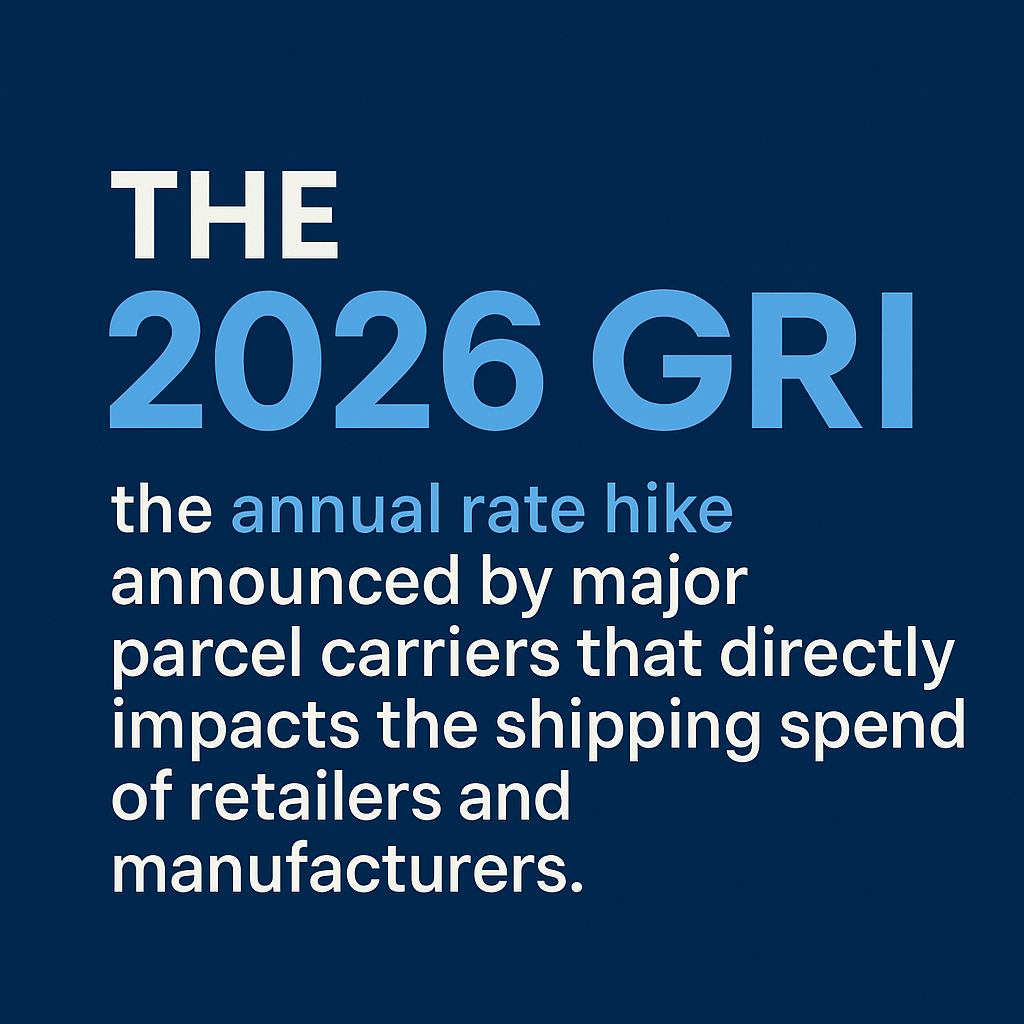
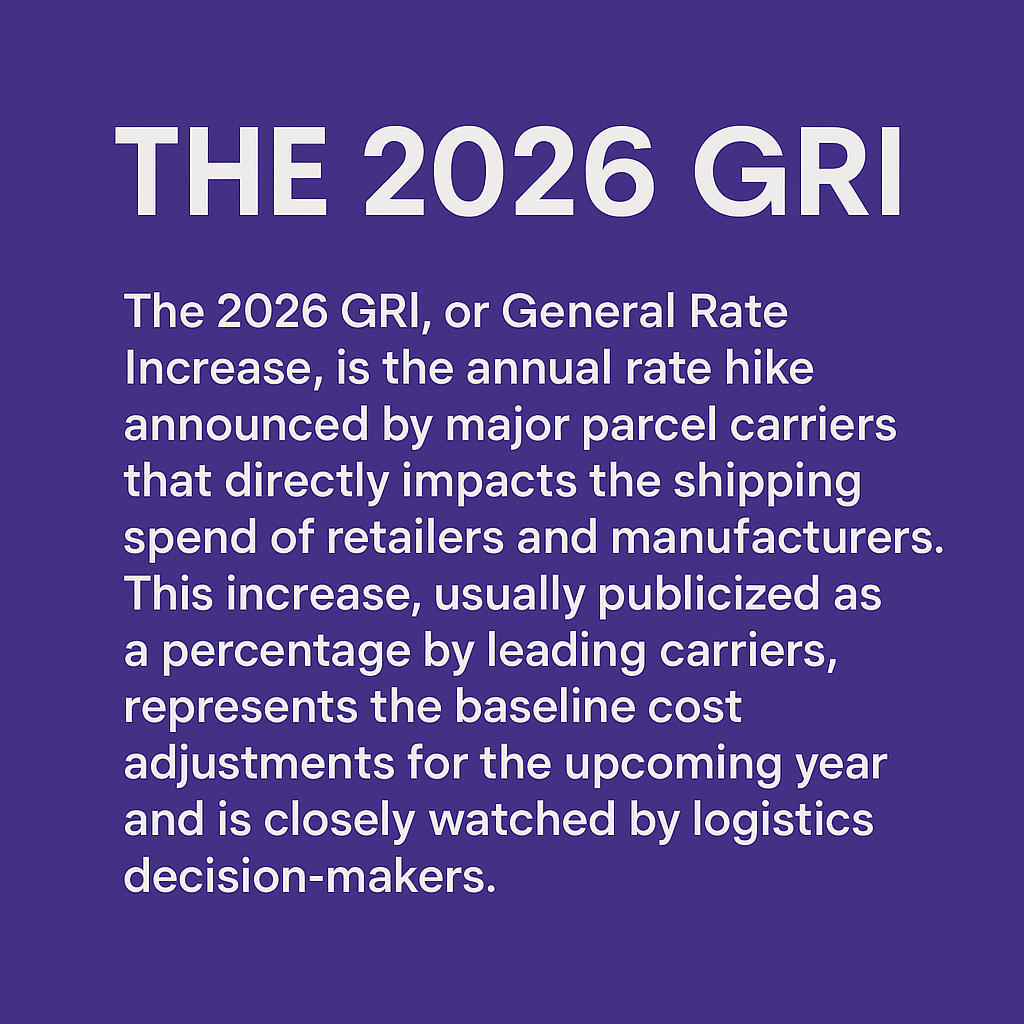
The 2026 GRI, or General Rate Increase, is the annual rate hike announced by major parcel carriers that directly impacts the shipping spend of retailers and manufacturers. This increase, usually publicized as a percentage by leading carriers, represents the baseline cost adjustments for the upcoming year and is closely watched by logistics decision-makers. For business leaders in retail and manufacturing, the GRI sets the financial landscape for supply chain operations, dictating how much more budget must be allocated to getting products into customers' hands and components to factories.
Each year, carriers like UPS and FedEx roll out their annual GRI, typically announcing these figures several months in advance. The process is simple on the surface: carriers declare a headline percentage increase (such as the now-familiar 5.9% of recent years), intended to set market expectations. However, this number is merely a starting point and often underrepresents the true impact for shippers whose unique shipping profiles—volume, package dimensions, destination types, and service levels—will ultimately dictate their real-world cost increase.
Why are these announcements so critical to retail and manufacturing logistics leaders? First, the GRI is not just about managing cost—it's about margin protection and supply chain resilience. Even a modest-seeming rate hike can quickly cascade into significant budget overruns if businesses are unprepared. Over the past decade, historical GRI trends have steadily climbed, contributing incrementally to higher supply chain costs and putting renewed pressure on logistics leaders to find savings elsewhere to preserve overall profitability.
For 2026, industry watchers anticipate several possible changes: evolving carrier pricing strategies, heightened surcharges, and increased focus on large or overweight parcel fees—each of which will affect how the 2026 GRI plays out for various sectors. Understanding both the headline rate and the underlying microcharges is essential for business leaders who want to proactively safeguard their bottom line and optimize their logistics spend.
With ShipSigma, business leaders can face the uncertainty of the 2026 GRI with confidence. Our proprietary technology and expert guidance empower companies to see beyond the posted rate increases, delivering clear strategies to control costs and preserve margins. Start your path to smarter shipping and greater savings—without changing your carriers, only the outcome.
The difference between a carrier's announced rate increase—such as the headline 5.9% General Rate Increase (GRI)—and what shippers in retail and manufacturing actually face can be substantial. While carriers typically promote an "average" increase across all services, the real-world impact is far more variable. Many businesses with complex shipping profiles often experience increases well into the double digits due to a combination of shipment characteristics, service selections, and the stacking of multiple surcharges. Understanding this gap is vital for business leaders, as underestimating shipping cost escalation can erode profit margins and disrupt supply chain budgets.
Announced GRIs are calculated across all service levels and package types, but the real shipping cost impact depends heavily on your specific shipping profile. For instance, companies shipping a larger volume of oversized or residential packages often feel rate hikes in those categories far exceed the advertised average. Service level selection—such as air versus ground—and shipment origin/destination lanes all play a role in determining your effective rate increase. This means that the 5.9% increase could become 10-15% for certain businesses if their shipments align with categories seeing steeper surcharges or service-specific hikes. The 2026 fuel surcharge formula change shows this gap in action: the 5.9% GRI becomes the real 2026 invoice increase once the higher percentage is applied to an already-raised base.
Retailers and manufacturers typically operate across a diverse set of product sizes, delivery points, and seasonal peaks. Carriers extract higher fees by targeting surcharges and rate increases at the shipment types most common to these industries, such as those requiring Additional Handling, Large Package processing, or extensive last-mile delivery. Consequently, the compounded effect of multiple surcharges means retail and manufacturing leaders are rarely insulated by the published GRI—it is often just the tip of the iceberg.
For example, ShipSigma's proprietary data has shown that while one client anticipated a manageable 6% hike based on carrier communications, their actual year-over-year spend rose by nearly 13%. This was due to a blend of higher fuel surcharges, new accessorial fees, and substantial increases on frequently used services. Without a granular, shipment-level analysis, these hidden increases can blindside even the most diligent business leaders.
Identifying your business's unique shipping profile—including factors like package size distribution, average zone, and service mix—is critical to accurately forecast and manage the true scope of GRI-related cost increases. ShipSigma specializes in dissecting shipping data to model the genuine expense increase, empowering businesses to negotiate contracts with precision and confidence. Relying solely on carrier announcements leaves your organization vulnerable to unexpected cost escalations and missed savings opportunities.
In a shipping environment defined by complexity and variability, ShipSigma is your strategic partner for controlling costs. Our expert team leverages advanced analytics and proven negotiation tactics to ensure that your realized shipping rate increase never outpaces your expectations. Ready to discover the true impact of GRIs on your business—and claim real savings? Reach out to ShipSigma for a tailored cost analysis and strategic plan that keeps your supply chain resilient and your margins healthy, no matter how rates change.
While the annual shipping rate increase—the General Rate Increase (GRI)—often grabs the headlines, retail and manufacturing shippers know the real costs go well beyond these published numbers. For 2026, key carrier surcharges such as Additional Handling and Large Package fees are increasing at a much higher rate than the base GRI. In many situations, these surcharges are rising by 7% to over 9%, outpacing the average GRI and dramatically impacting your bottom line. Understanding and proactively managing these increases is essential for controlling shipping fees and staying competitive.
Three of the most significant surcharge increase categories are Additional Handling, Large Package fees, and Delivery Area Surcharges. Additional Handling applies to parcels that exceed certain size, weight, or packaging criteria—a common occurrence for manufacturers shipping non-standard goods and retailers sending out bulk or oversized orders. Large Package fees hit shipments that fall outside standard dimensions especially hard, which is customary in both sectors. Delivery Area and Residential Surcharges amplify costs for shipments destined for less accessible locations or homes, a frequent scenario in today's e-commerce-driven retail environment.
One of the most challenging realities for shipping teams is the compound effect—when a parcel faces two or more surcharges. For example, a large package requiring additional handling and being sent to a remote area could accrue surcharges that collectively exceed the annual GRI by several multiples. This layered cost structure has a disproportionate impact on businesses with complex product catalogs or broad geographic coverage. Each additional surcharge not only raises the per-shipment cost but can quickly multiply across thousands of orders, significantly increasing your annual logistics spend.
Consider a retailer shipping furniture to consumers nationwide. The base GRI for 2026 might be 5.9%, but if shipping profiles involve large, heavy packages to residential or rural addresses, total per-shipment costs may balloon by 15% or more due to surcharges. Factoring in the higher rates for both Additional Handling and Large Package fees, along with Delivery Area Surcharges, the total cost is far above the headline rate—often catching finance and operations leaders off guard if not closely monitored. This example underscores why understanding and negotiating around these fees is crucial for true cost control.
To stay ahead, business leaders must do more than watch GRIs—they need targeted strategies to recognize, model, and control the surcharges that quietly swell shipping costs. ShipSigma specializes in identifying these hidden drivers and leveraging proprietary analytics to ensure your business gets the lowest possible shipping spend. Partner with our technology and expert team to uncover actionable savings opportunities—in all the places traditional GRI conversations miss—so you can protect margins and support growth even in a rising fee environment.
Effectively estimating the true impact of carrier rate increases on your shipping spend requires a more granular approach than simply applying the announced General Rate Increase (GRI) percentage to your previous year's costs. The real story lies in shipment-level analysis, where each cost component—including surcharges and accessorial fees—is dissected and projected for the coming year. For retail and manufacturing shippers, overlooking these factors can easily lead to underestimated budgets, profit margin erosion, and disrupted supply chain strategies.
Rather than relying on macro-level assumptions, business leaders should leverage detailed shipping spend analysis and robust cost modeling tools that account for every shipment's unique attributes—parcel size, weight, service level, destination, and frequency. Advanced analytics allow companies to forecast not just base shipping rate impacts, but also the often-significant increases in surcharges like Additional Handling and Large Package fees. With many surcharges rising at faster rates than base GRIs, failure to model at the granular level can leave 'invisible' costs unaddressed until it's too late.
Modern logistics strategy depends on reliable data. The best forecasting tools ingest your actual historical shipping records, enabling simulation of various GRI and surcharge scenarios. ShipSigma's proprietary technology, for example, leverages over $1 billion in annual spend data and predictive analytics to deliver precise, shipment-level cost modeling. This not only highlights your exact cost exposure but also pinpoints where optimization and negotiation can yield immediate, measurable savings—down to the penny.
To deliver accurate forecasts, leading organizations standardize and automate the inclusion of all likely surcharges and accessorial fees in their annual shipping budgets. This requires tracking the frequency and magnitude of each fee, identifying which service levels and package characteristics trigger additional charges, and flagging new or rising fees that may appear in the next carrier contract cycle. ShipSigma's modeling and reporting capabilities make this process seamless, empowering you with the clarity and confidence needed for more accurate financial planning.
Utilize your historical shipment data as a baseline, then apply GRI and projected surcharge increases at the shipment level, rather than using flat averages. Evaluate the effect of changes in package mix, delivery zones, and service preferences. Regular scenario analyses, powered by tools like ShipSigma's, allow you to stress-test potential contract revisions or operational shifts before making costly decisions. These best practices help retail and manufacturing leaders develop data-driven budgets and logistics strategies that protect margins, even in a volatile rate environment.
Unlock predictable shipping savings and take command of your logistics strategy. ShipSigma's advanced cost modeling doesn't just forecast your shipping spend—it exposes every savings opportunity and risk, empowering you to negotiate strong contracts and optimize spend without changing your carriers or sacrificing service. Discover the clarity and savings precision that hundreds of retail and manufacturing leaders already trust to drive results.
For business leaders in retail and manufacturing, grappling with annual General Rate Increases (GRIs) can feel like an unavoidable reality—especially when switching carriers would disrupt critical supply chain flows. Fortunately, effective shipping cost mitigation strategies exist that allow you to combat GRI-driven increases without abandoning established carrier relationships. Harnessing a blend of data-driven insights, disciplined contract renegotiation, and shipment profile optimization, these approaches have helped many organizations hold the line on shipping costs and safeguard their margins year over year.
Carrier contract negotiations are most successful when backed by robust, credible data. Rather than accepting base rate increases at face value, use detailed shipment data and cost modeling to benchmark your performance against similar businesses in your sector. Platforms like ShipSigma provide access to thousands of benchmarking points and historical rate scenarios, arming you with irrefutable leverage when pressing for concessions or targeted discounts. By clearly demonstrating your shipping patterns—down to zone, service level, and parcel characteristic—you can often negotiate protection from certain surcharges or win retention incentives that blunt the impact of annual GRIs.
Industry benchmarking turns the negotiation process from a one-sided conversation into a genuine business partnership. By comparing your current rates and surcharge exposure against a broad landscape of similar shippers, you'll uncover gaps—and opportunities—that would otherwise go unnoticed. Pair this with a granular shipment analysis, focusing on package dimensions, frequency, and typical destinations, to strategically adjust your shipping profile. Streamlining packaging to avoid oversized fees, consolidating deliveries, or tweaking pickup schedules can yield immediate cost avoidance without service compromise.
ShipSigma's expert team delivers unmatched value by pinpointing cost-saving opportunities, even within your existing carrier partnerships. Our technology identifies inefficiencies, negotiates favorable contract amendments, and proactively manages surcharge triggers—allowing you to control spend while maintaining the preferred service levels and operational familiarity your business requires. Case studies show that, with the right analytics and negotiation strategy, companies can capture significant savings—sometimes in the high six-figures—without the upheaval and risk of carrier switching.
For retail and manufacturing shippers, surcharges tied to Additional Handling and Large Package fees make up an outsized portion of the annual shipping bill. Proactively mitigating these requires creativity and discipline: review packaging dimensions, separate out irregularly-shaped shipments, and train teams on proper labeling and manifesting. In addition, work with logistics partners or consultants to identify consolidation opportunities and alternative service levels for zones hit hardest by Delivery Area or Residential surcharges. Deploying these tactics systematically can soften the blow of even the steepest GRIs.
At ShipSigma, we believe meaningful savings are always within reach—even in turbulent rate environments. With our proprietary analytics platform and negotiation expertise, your company can outmaneuver rising costs while keeping your trusted carriers and service options intact. Let us help you unlock the next level of shipping optimization—and preserve your margins in the face of the 2026 GRI.
In an environment where shipping rates are rising steadily—often outpacing headline General Rate Increase (GRI) announcements—retail and manufacturing shippers face unprecedented pressure to control costs without sacrificing carrier relationships or operational consistency. ShipSigma delivers quantifiable savings by combining proprietary technology, unmatched shipping intelligence, and industry expertise to optimize your parcel spend, all while keeping your chosen carriers and service levels intact. This ensures that businesses can keep their focus on growth and customer satisfaction, rather than on deciphering complex rate sheets or worrying about disruptive changes to their logistics networks.
Unlike traditional consulting or self-serve rate negotiation approaches, ShipSigma leverages state-of-the-art contract negotiation technology paired with a team of logistics experts. Our platform analyzes your unique shipping profile in depth, benchmarking it against billions of dollars in actual shipping spend. This data-driven approach highlights areas where you may be overpaying and identifies attainable, custom savings targets—often going well beyond what's possible through generic GRI calculations. ShipSigma does the heavy lifting for you, providing actionable insights and recommendations that are tailored for your business's shipping patterns, not just industry averages.
ShipSigma doesn't just secure one-time savings. By constantly monitoring invoice-level data and modeling future rate changes, we drive ongoing optimization and ensure you're shielded from hidden increases such as surcharges, accessorials, and other carrier line items. Our technology recalibrates as your business evolves—whether you're rolling out new distribution models, scaling e-commerce channels, or adjusting to seasonal demand. This continuous improvement safeguards your margins in the face of rising shipping costs year after year.
For retail and manufacturing clients, the impact is tangible. Case studies routinely show double-digit percentage reductions in net shipping spend without any change in carriers or disruption to fulfillment workflows. By re-negotiating contracts with a level of precision and expertise that carriers recognize and respect, ShipSigma empowers your business to secure the lowest possible rates—even as rate environments grow tougher. Our clients benefit not only from initial cost reductions but also from long-term resilience and visibility into their logistics costs.
Launching your savings journey with ShipSigma is straightforward and risk-free. It begins with a detailed, no-obligation shipping analysis, in which we quantify opportunities for savings based on your actual data. There's no need to switch carriers or disrupt operations—just expert guidance and technology-driven insights at every step. Our team partners with you from analysis and negotiation through ongoing optimization, delivering savings you can count on, now and as the shipping landscape evolves.
The 2026 GRI, or General Rate Increase, is the annual rate adjustment announced by major parcel carriers such as UPS and FedEx that sets new baseline shipping costs for the year. Carriers publicize a headline percentage (the 2026 figure is 5.9%) months in advance, but that number represents an average across all service levels and package types. Shippers with complex profiles commonly see effective increases well exceeding the headline rate due to surcharge stacking and service-specific hikes.
For 2026, Additional Handling and Large Package fees are rising by 7% to over 9%, outpacing the 5.9% base GRI. Delivery Area Surcharges are also increasing, compounding the cost impact for retail and manufacturing shippers whose parcels regularly qualify for multiple fees. A single shipment that triggers two or more surcharges faces a total per-shipment cost increase several multiples beyond the headline rate.
Surcharge stacking occurs when a parcel exceeds size or weight thresholds (triggering Additional Handling or Large Package fees) and is also destined for a residential or remote address (triggering Delivery Area or Residential Surcharges). Furniture retailers, manufacturers of non-standard goods, and any shipper with heavy residential volume are especially exposed to this layering. Each surcharge compounds independently, so a single shipment faces cost increases far beyond the headline GRI.
Collect average package weight, shipment volumes by service level, primary shipping zones, dimensional weight percentages, and the frequency of packages that trigger Additional Handling or Large Package thresholds. Carriers enter negotiations with detailed data on your account, so arriving with matching metrics levels the discussion. Knowing the share of residential and extended delivery area shipments is particularly important, as those categories carry the steepest surcharges.
Applying the headline GRI percentage to last year's total spend ignores surcharge-level variation across package types, service levels, and delivery zones. Shipment-level modeling projects costs for each individual shipment using actual size, weight, destination, and service attributes, then layers in current and projected surcharge rates. This granular approach surfaces the hidden cost exposure that flat-percentage estimates routinely miss by tens of thousands of dollars annually.