
What Is the General Rate Increase (GRI) In Shipping for 2024?
As a shipper, you know that even small changes in shipping rates can have significant effects on your bottom line. That's why it is important to stay informed about various factors that can impact your shipping costs. One such factor is the General Rate Increase (GRI). In this post, we'll explore G…

As a shipper, you know that even small changes in shipping rates can have significant effects on your bottom line. That's why it is important to stay informed about various factors that can impact your shipping costs. One such factor is the General Rate Increase (GRI). In this post, we'll explore GRI in shipping to understand its significance and how to navigate it for cost-effective cargo transportation.
Have Shipping Rates Increased?
Parcel Shipping Rates
To determine whether and how much shipping rates have increased in the last few years, let's compare UPS and FedEx rates for the years 2021, 2022, 2023, and 2024. For this illustration, we will use the rates of shipping a 20-pound package to the nearest zone.
2021 Vs. 2022 Vs. 2023 Vs. 2024 Parcel Shipping Rate Comparison
UPS Rate Increase History
Service — 2021 — 2022 — 2023 — 2024
UPS Next Day Air Early — $95.31 — $100.20 — $106.16 — $112.17
UPS Next Day Air — $65.31 — $70.20 — $76.16 — $82.17
UPS Next Day Air Saver — $62.14 — $66.80 — $72.48 — $77.92
UPS 2nd Day Air A.M. — $44.73 — $47.64 — $ 51.40 — $54.94
UPS 2nd Day Air — $42.24 — $44.30 — $47.62 — $50.23
UPS 3 Day Select — $29.10 — $31.98 — $34.38 — $35.92
UPS Ground — $14.29 — $15.14 — $ 16.10 — $17.02
FedEx Rate Increase History
Service — 2021 — 2022 — 2023 — 2024
FedEx First Overnight — $95.79 — $100.64 — $106.55 — $112.51
FedEx Priority Overnight — $64.79 — $69.64 — $75.55 — $81.51
FedEx Standard Overnight — $61.52 — $66.13 — $71.75 — $77.13
FedEx 2Day A.M. — $44.27 — $48.47 — $52.29 — $55.89
FedEx 2Day — $42.24 — $44.30 — $47.62 — 50.23
FedEx Express Saver — $37.43 — $41.13 — $44.21 — $46.19
FedEx Ground and FedEx Home Delivery — $14.32 — $15.25 — $16.21 — $17.13
From the data in the tables above, we can tell that shipping rates have steadily increased year over year due to GRIs being applied by FedEx, UPS, and other carriers.
Freight Shipping Rates
Between 2019 and 2023, there was a significant fluctuation in freight shipping rates. This was mainly driven by the COVID-19 pandemic, which led to a surge in online consumer spending, causing logistical networks of shipping carriers to become overwhelmed not only in 2020 but for several years afterward. This increased demand for shipping services resulted in higher shipping rates, with rates reaching their peak in September 2021, as reported by Statista data.
However, as of mid-2023, the global shipping rate index has largely returned to levels similar to those seen before the pandemic:
In September 2021, the global freight rate index stood at 10,400 U.S. dollars.
In June 2023, the index had decreased significantly to 1,500 U.S. dollars.
This indicates a notable decrease in shipping rates from their peak during the pandemic, bringing them back in line with the pre-pandemic levels.
What Does GRI Mean in Shipping?
GRI meaning in shipping: GRI is an acronym for the term General Rate Increase. Sometimes, it might be referred to as an annual percentage increase. It represents an adjustment in shipping rates, typically implemented by carriers on a yearly basis. Note, GRI is different from things like fuel surcharges, and peak season operating costs. GRI accounts for changes in the supply chain, raw materials, and other factors that can vary significantly, impacting overall shipping costs, and causing carriers to raise prices.
What Is a General Rate Increase? Is It the Same as Rising Costs?
A General Rate Increase (GRI) is a scheduled and price hike implemented by shipping carriers to adjust freight rates in response to various industry challenges like rising operational costs or market fluctuations.
Shipping carriers apply GRI fees in response to market changes, such as the escalation of fuel costs or the need to maintain profitability within a fiercely competitive market. Transparency is key in this process; carriers typically announce GRIs well in advance, providing customers with a window of opportunity to prepare for impending rate increases.
General rate increases offer carriers a means to adapt swiftly to the ever-changing market conditions. However, the impact of GRIs isn't limited to carriers alone; customers who rely on shipping services can experience financial implications. Therefore, effective negotiation and proactive planning on the shipper's part are crucial to help avoid losses or very high shipping costs.
Sometimes, GRIs are not applied across the board. They can be implemented on specific shipping services, trade routes, or geographic regions. This diversity in application results in fluctuations in the areas and sectors where the rate increases have an impact.
What Is the Annual General Rate Increase 2024?
Both UPS and FedEx have announced general rate increases to be effected in late 2023 and early 2024. These are discussed below
What Is the 2024 General Rate Increase (GRI) in Shipping for UPS?
UPS recently announced the following information on the 2024 UPS Daily Rates General Rate Increase:
Starting December 26, 2023, UPS Daily Rates for services will increase. UPS states the reason for these rate adjustments is to aid ongoing capacity and capability enhancements.
Below is an overview of the expected changes outlined in the UPS 2023 rate increase announcement:
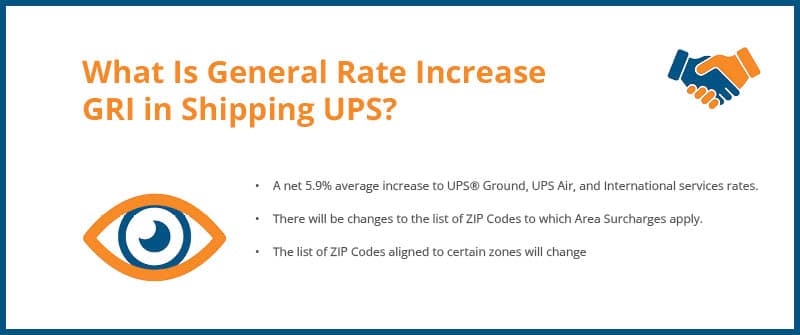
A net 5.9% average increase to UPS® Ground, UPS Air, and International services rates.
There will be changes to the list of ZIP Codes to which Area Surcharges apply.
The list of ZIP Codes aligned to certain zones will change
Apart from the base rates, the surcharges & fees for UPS will also have changes. View the details here.
See the full details of UPS rate changes in their 2024 Rates pdf.
These changes are bound to affect the shipper's budgets. How these alterations will affect your shipping expenses will depend on your specific shipping attributes and the terms outlined in your UPS contract.
What Is 2024 General Rate Increase (GRI) in Shipping for FedEx?
On August 29, 2023, FedEx announced changes in shipping rates for FedEx Express, FedEx Ground, and FedEx Freight, to be effected on January 1, 2024. FedEx's general rate increase 2023 details are as follows:
FedEx Ground and FedEx Express Rate Changes
FedEx Express shipping rates will increase by an average of 5.9% for U.S. domestic, U.S. export, and U.S. import services.
FedEx Ground and FedEx Home Delivery shipping rates will increase by an average of 5.9%. FedEx Ground Economy shipping rates will also increase.
Apart from the base rates, the surcharges & fees for FedEx Express & FedEx Ground will also have changes. View the details here.
Effective January 1, 2024, FedEx will be increasing customs clearance service fees on imports.
Effective January 15, 2024, FedEx will assess the Additional Handling Surcharge and Oversize Charge per eligible package for international multi-piece shipments instead of per shipment.
Check out the 2024 FedEx Express and FedEx Ground rates (PDF) for full details.
FedEx Freight Rate Changes
FedEx Freight shipping rates will increase by an average of 5.9%-6.9%, dependent on the customer's transportation rate scale. There will also be changes to FedEx freight shipping surcharges.
Please check your FedEx shipping agreement to determine the net impact of these changes on your shipping costs.
What Is GRI in LTL?
First Of All, What Is LTL?
LTL stands for Less Than Truckload, a cost-effective freight shipping method that involves the consolidation of multiple smaller shipments from different shippers into a single truck for transportation.
This approach allows businesses to efficiently move goods that don't require the entire capacity of a standard truck, optimizing resource utilization and reducing shipping expenses.
What Is The GRI In LTL for 2023?
Less-than-truckload (LTL) carriers can use General Rate Increases (GRIs) to adjust their base rates to accommodate challenges in their operations. These price adjustments are made according to general freight tariff codes and may fluctuate depending on factors such as shipping routes and weight categories.
The GRI percentage (LTL general rate increase 2023) announced by carriers represents the anticipated average increase that these rate adjustments will have across all affected accounts.
ShipSigma Can Lower Your Shipping Costs
At ShipSigma, we leverage over $1 billion of live market data, as well as 150+ years of collective shipping industry experience, to find the best cost-saving opportunities for your company.
To date, we have helped over 300 customers to achieve an average of 25% in cost savings. That's a significant impact the bottom line. Ready to get started?/contact-usContact us today to discuss your shipping strategy and get your total cost down.
Frequently Asked Questions About General Rate Increases in Shipping
How often do carriers implement a general rate increase?
Both UPS and FedEx implement general rate increases on an annual basis, with adjustments taking effect in late December or early January. The 2024 cycle saw UPS rates change on December 26, 2023 and FedEx rates change on January 1, 2024. Shippers who track the annual announcement cycle are better positioned to forecast the cost impact before the new rates take effect.
How much did UPS and FedEx raise rates in 2024?
Both UPS and FedEx implemented a net average increase of 5.9% on their core parcel services effective in late 2023 and early 2024. For UPS, this covered Ground, Air, and International services; for FedEx, it applied to Express, Ground, and Home Delivery. FedEx Freight increases ranged from 5.9% to 6.9% depending on the customer's transportation rate scale.
Is a GRI the same as a fuel surcharge?
A General Rate Increase and a fuel surcharge are separate charges applied by carriers. The GRI is a scheduled adjustment to base rates that accounts for supply chain changes, raw material costs, and operational factors, while a fuel surcharge is a variable fee tied to carrier energy cost index movements. Carriers apply both independently, so a shipper's total cost increase in any given year reflects each charge individually.
Do general rate increases apply to all shipping services equally?
General rate increases are not always applied across the board. Carriers apply GRIs selectively to specific shipping services, trade routes, or geographic regions, so some shipment types absorb larger percentage increases than others. Reviewing the carrier's full rate announcement each year reveals which services and zones are affected.
How do LTL carriers apply general rate increases?
LTL carriers use General Rate Increases to adjust their base rates in line with their general freight tariff codes, with adjustments varying by shipping route and weight category. The announced GRI percentage represents the anticipated average increase across all affected accounts, not a uniform charge applied to every shipment. Shippers with LTL volume should compare the announced percentage against their specific rate scale to determine the actual cost impact.