
FedEx Contract Negotiation, Backed by Live Market Data
ShipSigma's cost modeling analyzes your actual shipping data and produces a guaranteed savings figure for your FedEx agreement. You see the number first. You only pay if we deliver it.

Featured In









Cost Modeling Platform
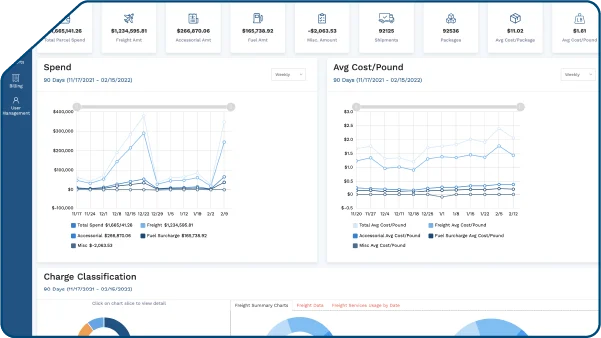
Our analysis pinpoints exactly where your FedEx contract is overpaying, drawn from 20 billion live market data points.
- Live market rate intelligence
- Every negotiable lever including base rates, accessorials, dim factor, GRI caps, and rebate incentives
- Guaranteed savings
- Specific dollar figure before you sign
- Average 25.2% reduction across FedEx engagements
- Same carrier
Lower Your FedEx Costs with Contract Engineering
“We could not say enough good things about our relationship with ShipSigma. Beyond the initial savings, they continue to find us new angles for savings, set up dashboards specific to our needs, and meet with us quarterly to go through reporting/review savings/new opportunities. ShipSigma has been more than just a service for us, they have been a continuous partner as we navigate the difficulties of controlling our freight costs and holding the vendors accountable.”
“4 hours. It took less than 4 hours of my time for my company to see half a million in annual savings. No headaches, no feet-dragging negotiations, no confusing documents. It was so easy.”
“The insights and analytics, ShipSigma provided before and after negotiating our carrier agreements, make it clear we have a long-term partner who is aligned with our company values. The cost modeling and rate simulation let us know the exact savings we would see, down to the last cent. After running our historical data, ShipSigma was able to find us almost 28% in annual shipping savings with our same carrier.”
“Our team managed billions of dollars of various category spend. To have ShipSigma guarantee a savings and then fully execute so that we’re realizing increased EBITDA within 60 days allows us to focus on other strategic opportunities.”
“We thought we had the best rates. We were told we had the best rates. ShipSigma got us better rates. They found us nearly 25% in savings and helped us renegotiate our contract with our carrier. It was just so easy.”
“The parcel invoice audit was a lifesaver for us. The team at ShipSigma monitored the weekly audit and noticed that instead of shipping air, over 60% of our packages could have traveled ground with no delay in arrival. They saved us more money than we had ever saved in our manual audit process.”
FedEx Contract Negotiation
Every FedEx shipper negotiates contracts under the same condition: the shipper brings its own data, history, and volume, while FedEx brings two decades of pricing intelligence aggregated across millions of shippers with no obligation to share what it knows. That asymmetry is structural. It sets a ceiling on what any internal team can independently verify about its own contract.
ShipSigma closes the asymmetry. Cost modeling trained on more than 20 billion parcel and LTL data points identifies where carrier margin is embedded in a given FedEx pricing agreement and quantifies what is recoverable through structured negotiation. Every savings figure is presented before any commitment is signed. ShipSigma has served 350+ companies, delivered more than $150 million in customer savings, and produces a 25.2% average cost reduction across all engagements.
FedEx implemented a 5.9% general rate increase effective January 5, 2026, the third consecutive year of GRIs at that level. Headline percentages understate true cost movement. Residential delivery surcharges for FedEx Ground and Home Delivery rose 8.4% from $5.95 to $6.45 per package, Express residential surcharges rose 6.1% to $6.95, and address correction fees increased to $25.50 per correction. Shippers without contractual protections absorb the full compounding impact every cycle. The best time to renegotiate a FedEx contract is before it auto-renews, ideally 90 to 120 days in advance, though any business absorbing rising rates without a data-backed review is leaving recoverable savings in place regardless of contract position.
What is negotiable in a FedEx shipping contract?
Nearly every element of a FedEx contract is negotiable. FedEx's standard agreements are structured to obscure that fact. Base rate discounts by service type, including FedEx Ground, FedEx Express, and FedEx Home Delivery, are the most visible negotiation point and the most common starting position for any FedEx contract negotiation. They represent only a portion of total shipping spend.
Accessorial charges, including residential delivery surcharges, delivery area surcharges, address correction fees, and additional handling fees, are fully negotiable. For most shippers these line items represent 20% to 40% of total shipping cost. Shippers focused narrowly on base rate discounts leave this portion of the contract effectively unaddressed.
FedEx dimensional weight pricing rules directly affect cost for lightweight, bulky shipments. Negotiating a higher dim divisor or package-type carve-outs reduces rated weight across the affected portion of a shipper's volume. Apparel, consumer goods, and other low-density product categories see the largest impact from this lever.
Volume commitments and minimum spend thresholds are standard components of FedEx contracts. Understanding which commitment levels qualify for which discount tiers, and whether those tiers are achievable given the shipper's actual profile, is essential before signing. Peak season surcharges applied during Q4 and other high-demand periods are negotiable in both rate and applicability. Shippers who ship heavily during peak periods but accept standard peak surcharge structures absorb costs that better-positioned shippers have already capped or waived.
What shipping data should I prepare before negotiating with FedEx?
Before substantive FedEx contract negotiation begins, shippers need a minimum of 12 months of invoice-level shipping data. That data includes service type, zone distribution, package weight and dimensions, delivery area classifications, and every accessorial charge applied. Without it, FedEx controls the information advantage entirely.
Zone distribution sets the baseline for a meaningful FedEx rate negotiation. A disproportionate share of shipments moving through Zones 5 through 8 signals that base rate discounts on long-zone shipments are underperforming what is achievable. FedEx structures discount tiers knowing that most shippers do not perform this level of analysis.
Accessorial charge exposure must be calculated as a percentage of total spend. With address correction fees at $25.50 per correction in 2026, this single category produces tens of thousands of dollars annually for shippers with frequent corrections. Knowing the figure before negotiation produces a specific, documentable target rather than a generic ask.
Dimensional weight ratio across the shipment profile is the next required input. When a meaningful share of packages bills on dimensional weight rather than actual weight, dim factor and dim-divisor language becomes one of the higher-return items in FedEx contract optimization. Shippers who arrive with this analysis enter from a position of strength. AI-powered cost modeling closes the gap between what a shipper is paying and what the shipping profile actually warrants before a single conversation begins.
How do you negotiate a FedEx contract?
A structured FedEx contract negotiation is a sequenced process built on data and competitive pressure, not a single conversation with a FedEx account manager. Shippers who treat it as a single conversation accept a percentage point or two on base rates and miss the categories where contracts are actually won.
Conduct a full shipping cost analysis
Before negotiation begins, model current rates against what the shipping profile should be paying. Service mix, zone density, accessorial exposure, and surcharge frequency must each be analyzed at the invoice level. Entering negotiation without that analysis means accepting FedEx's framing of the conversation.
Establish target rates and non-negotiables
Define discount targets for each service tier, accessorial caps, surcharge waivers, and the minimum acceptable outcome before walking. Negotiations without defined targets end with shippers accepting modest concessions that fall short of what was achievable on paper.
Introduce competitive pressure with a UPS bid
A credible multi-carrier shipping strategy is the single most effective tool in any FedEx rate negotiation. FedEx responds to documented UPS quotes and demonstrated willingness to shift volume. Without that pressure, FedEx has limited incentive to improve its initial offer.
Negotiate accessorials and surcharges separately from base rates
FedEx representatives frequently offer improved base rate discounts while holding firm on accessorials. Because accessorials represent a substantial share of total spend, accepting that framing without addressing surcharges and fees produces the largest gap between negotiated savings and total cost reduction.
Secure contractual protections against future GRI erosion
Negotiate minimum discount floors, GRI caps, and surcharge escalation limits in writing. Without these protections, the value of today's rates erodes with every annual cycle. A 3.5% cap on annual base rate increases protects against a published GRI that runs higher.
Review and validate the final contract in full
Carrier contracts are complex documents with deliberate ambiguity in key provisions. Minimum net charge clauses, earned discount thresholds, and termination provisions deserve careful review before signature. Favorable termination language preserves negotiating room for the next cycle.
What are the hidden fees in a FedEx contract?
FedEx accessorial charges are the fastest-growing component of total carrier spend for most shippers. Over the past several years FedEx has expanded its fee schedule, increased rates on existing categories, and introduced new surcharge types. For many shippers, accessorial charges now represent a larger share of total FedEx spend than the base transportation rate itself.
FedEx fuel surcharge
The FedEx fuel surcharge is recalculated weekly and applied as a percentage of the transportation charge. FedEx publishes weekly fuel surcharge tables tied to the U.S. Energy Information Administration's weekly diesel fuel price index. Because the fuel surcharge is calculated after base rate discounts, the effective rate on actual spend is higher than most shippers realize. Negotiating a fuel surcharge cap or a separate discount is possible and frequently overlooked in FedEx contract discussions.
FedEx residential delivery and delivery area surcharges
The residential delivery surcharge for FedEx Ground and Home Delivery rose to $6.45 per package in 2026, an 8.4% increase from $5.95. The Express residential surcharge rose 6.1% to $6.95 per package. Delivery area surcharge ZIP code lists expanded as well, retroactively increasing costs for businesses shipping to addresses that previously fell outside the surcharge tier. Caps, flat-rate replacements, or waivers for specific ZIP code tiers should be secured directly in the contract by businesses with high residential or rural delivery volume.
FedEx address correction and additional handling fees
Address correction fees reached $25.50 per correction in 2026, up 6.25% from $24. For B2C shippers and businesses delivering to distributed commercial locations, this category alone represents a material recurring line item. Additional handling surcharges apply to packages exceeding dimensional or weight thresholds, irregular shapes, or special processing needs. Industrial, manufacturing, and distribution shippers regularly trigger additional handling on a meaningful share of volume without a negotiated cap.
FedEx peak surcharges
FedEx peak surcharges are applied during the Q4 and holiday window and have grown in both magnitude and duration. Peak surcharges sit outside standard contract language unless explicitly negotiated. Retail, e-commerce, and seasonal manufacturing operations should secure peak surcharge caps or discounts inside the FedEx carrier contract, not in side communications.
Audit as the second layer of surcharge defense
Even with favorable contract terms, surcharge billing errors occur. A FedEx invoice audit surfaces misapplied delivery area classifications, incorrect residential designations, and duplicate accessorial charges across every invoice cycle. Combining surcharge negotiation with systematic auditing ensures contracted rates are honored and that hidden fees do not erode negotiated savings over time.
Should you waive guaranteed service refunds in a FedEx contract?
FedEx frequently offers improved base rate discounts in exchange for a waiver of Guaranteed Service Refunds (GSRs), the refunds owed when FedEx fails to deliver within the contracted service window. The trade-off is presented as a straightforward value exchange. The actual financial calculation deserves direct analysis before acceptance.
GSR value depends on service mix and FedEx's on-time performance within specific lanes. A shipper with a high proportion of Express services and time-sensitive delivery requirements stands to lose more by waiving GSRs than a shipper running predominantly Ground volume.
To evaluate the trade-off objectively, calculate historical GSR recovery as a percentage of total Express spend. Strong on-time performance in the affected lanes makes the effective value of GSR rights modest. Inconsistent performance makes the surrender of those rights a meaningful financial concession.
Even when a waiver is accepted, performance guarantees or service credit provisions preserve some accountability for chronic service failures on critical lanes. The decision to waive GSRs should never be made in isolation from a full contract review. A waiver accepted as a concession in exchange for a modest discount, without quantifying the actual refund value being surrendered, is one of the most common and costly missteps in FedEx contract optimization.
How do I use UPS as leverage when negotiating with FedEx?
FedEx and UPS operate within a duopoly that gives both carriers significant control over rate information and pricing power. The most effective way to shift that dynamic is to demonstrate, with documented evidence, that the shipper is actively engaged with the competing carrier and prepared to move volume.
A formal UPS proposal reflecting the shipper's actual profile is the foundation of credible competitive pressure. A UPS quote structured around the same service mix and zone distribution as the FedEx spend produces a specific, comparable number to bring to the FedEx negotiation. A generic rate card is dismissed; a profile-matched bid is not.
Partial volume shifts strengthen the signal. A documented record of moving a portion of volume to UPS or another carrier raises FedEx's incentive to improve its offer substantially. The threat of volume loss is more persuasive than a stated intention.
A multi-carrier shipping strategy is more than a single-cycle tactic. For businesses spending $500,000 or more annually on parcel shipping, diversifying across carriers reduces dependency on a single carrier's pricing decisions and produces ongoing competitive pressure that improves rates at every renewal cycle. Working with a carrier-agnostic partner, one with no financial relationship with FedEx or UPS, ensures that the comparison brought to the table reflects what the shipping profile should actually cost rather than a surface quote FedEx can dismiss.
What mistakes should I avoid when negotiating a FedEx shipping contract?
A FedEx contract negotiation is as much about avoiding common errors as securing the right terms. Six recurring mistakes account for the majority of value left on the table by mid-market shippers. Each is preventable with the right preparation.
Focusing only on base rate discounts
Base rates are one component of total cost. Strong base rate discounts paired with standard accessorial rates, fuel surcharge structures, and peak surcharges deliver total cost reductions far below what the headline number suggests. A complete FedEx contract negotiation addresses every category.
Accepting the first offer without a structured counter-cycle
FedEx's initial proposal is not its best offer. Carriers expect negotiation, and the gap between an opening offer and what is achievable through data-backed counter-proposals is consistently substantial. Accepting initial terms without a structured counter leaves savings unrealized.
Failing to address GRI protections
Strong rates today erode without minimum discount floors and GRI cap provisions. Every annual cycle without contractual protections resets the negotiating position. Securing cap language at signing preserves the value of negotiated rates across the full contract term.
Ignoring volume commitment thresholds
FedEx contracts include minimum volume commitments tied to discount tiers. Signing with commitments the shipping volume does not reliably support can produce retroactive rate adjustments or loss of negotiated discounts mid-term. Volume commitments should reflect realistic shipping projections, not aspirational targets.
Negotiating without external data
FedEx has access to pricing data across millions of shipper relationships. A team negotiating with only its own invoice history operates at a fundamental information disadvantage. AI cost modeling trained on over 20 billion parcel and LTL data points closes that gap directly.
Treating contract negotiation as a one-time event
Carrier contracts require continuous management. Surcharges shift, ZIP code classifications change, and new fees appear between renegotiation cycles. Shippers who treat contract signing as the finish line rather than the starting point overpay in the intervals between renewals.
ShipSigma offers a no-cost, no-obligation analysis of historical FedEx shipping data and produces a guaranteed savings figure before any agreement is signed. Request a FedEx contract analysis using the form on this page. The response returns within 48 hours.
Frequently Asked Questions
How much can businesses save by negotiating a FedEx contract?
Savings vary by current contract structure, shipping volume, carrier mix, and surcharge profile. ShipSigma delivers a 25.2% average cost reduction across more than 350 client companies and over $150 million in customer savings to date. The savings outcome on any individual FedEx contract depends on the gap between the current pricing agreement and what is achievable for a shipper of the same profile in the current market.
What is the FedEx general rate increase and how does it affect my contract?
The FedEx general rate increase, or GRI, is the annual rate adjustment FedEx applies to its published rates each year. FedEx implemented a 5.9% GRI effective January 5, 2026, the third consecutive year of increases at that level. Shippers without minimum discount floors or GRI cap provisions absorb the full annual rate increase on base rates and surcharges simultaneously.
Can you negotiate FedEx accessorial charges?
Yes. Accessorial charges including residential delivery surcharges, delivery area surcharges, address correction fees, and additional handling fees are fully negotiable. For most shippers these line items represent 20% to 40% of total shipping cost, making them one of the highest-return categories in any FedEx contract negotiation.
How do FedEx fuel surcharges work in a contract?
The FedEx fuel surcharge is recalculated weekly and applied as a percentage of the transportation charge, tied to the U.S. Energy Information Administration's diesel fuel price index. The surcharge is calculated after base rate discounts, which means the effective rate on actual spend is higher than most shippers realize. A fuel surcharge cap or separate discount is negotiable and frequently overlooked.
What is FedEx dimensional weight pricing?
FedEx dimensional weight pricing calculates billable weight as package volume divided by a dim divisor. For lightweight, bulky packages, the dimensional weight exceeds actual weight and becomes the billed weight. Negotiating a higher dim divisor or package-type carve-outs reduces rated weight across the affected portion of a shipper's volume.
When is the best time to renegotiate a FedEx contract?
The best time to renegotiate a FedEx contract is before it auto-renews, ideally 90 to 120 days in advance. Any business absorbing rising rates without a data-backed review is leaving recoverable savings in place regardless of contract position. Annual GRI cycles and expanding surcharge categories make proactive review a foundational discipline of parcel spend management.