
What is a Contract Carrier Agreement | Definition
A contract carrier agreement is a legally binding document between a carrier (like UPS or FedEx) and a customer detailing terms and conditions, services, and fees to be provided by each party. This holds both parties accountable for their respective duties (i.e carriers to deliver packages on time,…
A contract carrier agreement is a legally binding document between a carrier (like UPS or FedEx) and a customer detailing terms and conditions, services, and fees to be provided by each party. This holds both parties accountable for their respective duties (i.e carriers to deliver packages on time, customers to pay for service) and allows for streamlined contract management and compliance. A carrier agreement often referred to as a motor carrier agreement is most commonly discussed and altered through a carrier contract negotiation.
Common Carrier vs Contract Carrier vs Private Carrier
Carrier agreements are used with common carriers, contract carriers, and private carriers.
What is a Common Carrier?
A common carrier is a "business enterprise that transports goods and people from one location to another." This could be a shipping carrier transporting packages to a bus line transporting people. In this case, carrier agreements are often agreed upon between the individual consumer and the carrier. For example, when a consumer goes to their local UPS to ship a package, they pay a certain price for the package to be delivered by a certain day and/or time. Common carriers can serve anyone, and the agreements made are often short-term single-use agreements. Examples of common carrier companies include UPS, Fedex, and Southwest Airlines.
What is a Contract Carrier?
A contract carrier differs from a common carrier in that they serve specific companies. Contract carriers are often contracted to serve these companies over an agreed upon timeframe because the agreement can be terminated, negotiated, or removed. Contract carriers can also offer the shipment or transportation of high-risk materials like medical supplies and gases. These specialty supplies require expert handlers which are supplied by contract carriers. The most common examples of contract carrier companies are UPS & FedEx.
What is an example of a private carrier?
A private carrier is when a company owns its own vehicles to transport its own goods or services. They are not for hire, and therefore not accessible to the individual consumer or company. Typically, we see this in car manufacturers, but other examples include Coca-Cola and Wal-Mart. Semi-trucks are the most common form of transportation for private carriers, however, their fleets could include aircrafts, railcars, or even ships.
Companies That Move the Most Freight
Companies that move the most freight are typically a mix between common, contract, and private carriers. The top three companies in 2021 were XPO Logistics, UPS, and DHL. However, to even begin moving the freight, carriers of all kinds must be provided with a carrier packet.
What Does a Carrier Packet Include?
A carrier packet, also known as a broker packet, is a collection of documents to help facilitate carrier set up and approve them to haul freight. Without all of the necessary forms/agreements in place, carriers are more susceptible to improper onboarding and increased risk.
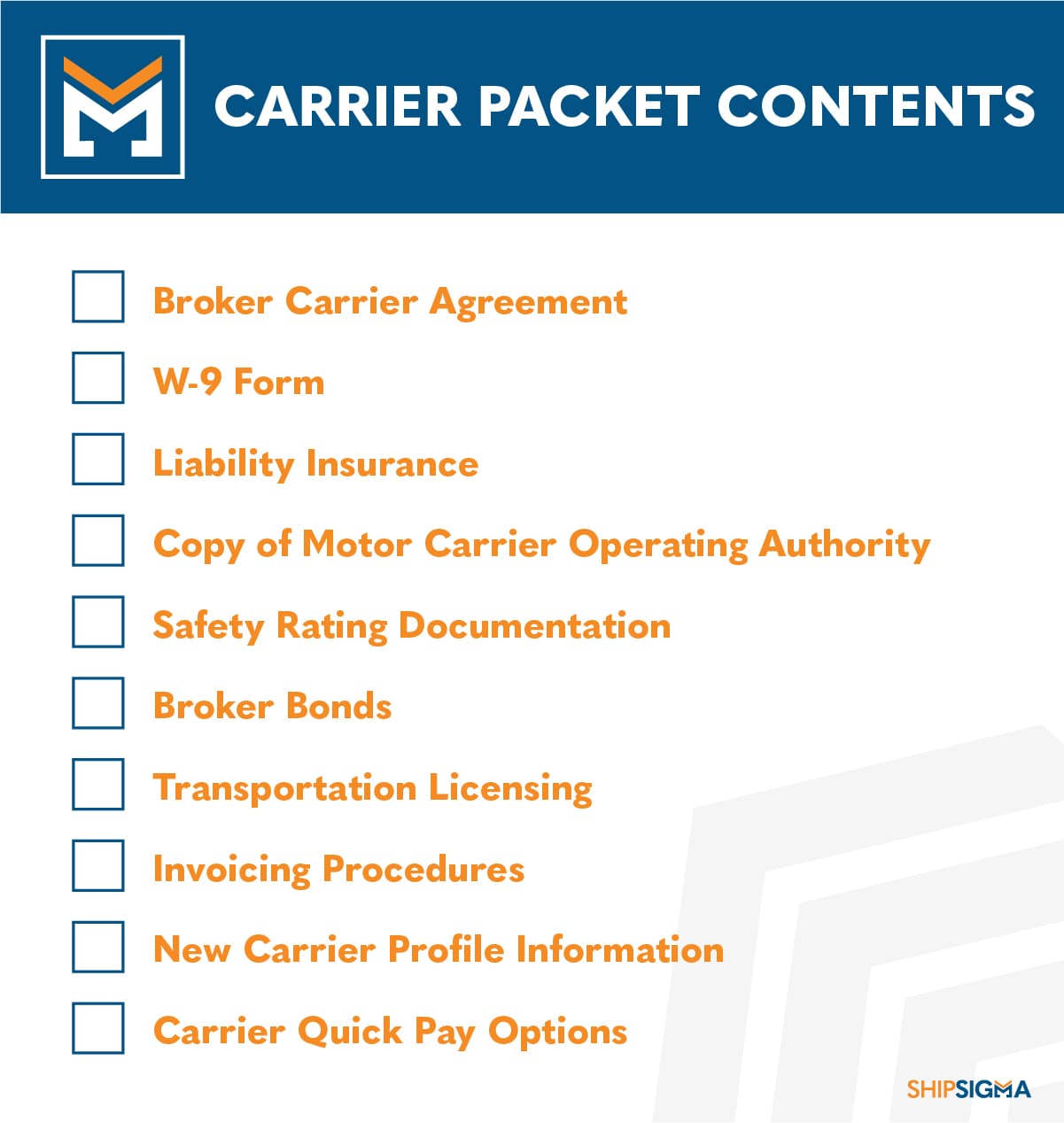
Carrier Packet Contents
Broker-Carrier Agreement: Includes the agreement date, number of days until payment, invoicing procedures, insurance requirements, and the carrier's Motor Carrier (MC) number.
W-9 Form: Must be completed with the amount of income to be paid to the carrier
Liability Insurance: Carriers must provide an insurance certificate showing that they have the minimum required amount of liability insurance.
Copy of MC Operating Authority: MC numbers (assigned by the FMCSA) indicate that carriers have the legal right to provide transportation of property.
Safety Rating Documentation: Carrier must provide their motor carrier safety ratings.
Broker Bonds: Proof of freight broker surety bond is required.
Transportation Licensing: Proof of proper driver's license to operate the truck legally
Invoicing Procedures: Where to send documents to receive payment after delivery
New Carrier Profile Information: All carrier identifying information for onboarding (i.e Carrier Company Name, Mailing Address, MC Number, Federal ID Number, DOT Number, and Standard Carrier Alpha Code Number).
Carrier Quick Pay Options: If offered by broker.
Negotiate Your Carrier Contract with ShipSigma
We are experts in carrier contract negotiation, we do it every single day. With our ai-powered platform, we know how much we can save you before we negotiate. We go beyond baseline rates and provide cost modeling and rate simulation so that you know exactly how your rates stack up.
Our mission is simple, we're here to save you money. Our customers see an average of 25.2% savings. Thinking about negotiating your contract? Contact us today to get started.
Frequently Asked Questions About Contract Carrier Agreements
Frequently Asked Questions
What types of shipments can a contract carrier handle that a common carrier cannot?
Contract carriers are authorized to transport high-risk specialty materials, including medical supplies and industrial gases, which require expert handlers. Common carriers serving the general public do not offer this capability. This specialization is why businesses with regulated or sensitive freight enter into dedicated carrier agreements rather than relying on standard shipping services.
What happens if a carrier packet is missing required documentation?
Missing required documents expose a carrier to improper onboarding and increased operational risk within the freight network. The broker-carrier agreement, insurance certificate, MC Operating Authority copy, and safety rating documentation are all mandatory for approval to haul freight. Gaps in any of these items delay carrier setup and prevent the carrier from legally moving loads.
What is a broker-carrier agreement?
A broker-carrier agreement is a contract between a freight broker and a carrier that specifies the agreement date, payment terms, invoicing procedures, insurance requirements, and the carrier's MC number. It is one of the core documents in a carrier packet required before a carrier is approved to haul freight. The agreement protects both parties by setting clear expectations for payment timing and liability coverage.
What insurance documentation must a carrier provide during onboarding?
Carriers are required to submit an insurance certificate demonstrating they carry the minimum required amount of liability insurance as part of the carrier packet. Freight broker bonds, which serve as proof of surety bond coverage, are also required documentation. Together, these documents verify that the carrier has adequate financial protection before being approved to haul freight.
What is the purpose of a Motor Carrier (MC) number in a carrier agreement?
An MC number, assigned by the Federal Motor Carrier Safety Administration (FMCSA), certifies that a carrier has the legal right to transport property for hire. This number appears in both the broker-carrier agreement and the copy of MC Operating Authority sections of a carrier packet. Carriers without a valid MC number are not authorized to haul commercial freight under federal regulations.